Finally Getting Dirt!
Not to be confused with finally getting dirty. I’ve wanted to get a load or two of fill dirt for the Barkyard for years now. More so lately to help restore the pleasing waterfall scene behind the bridge. How else will we rebuild Mount Crumpet? But seriously, there are now many more places that need fill, beyond having “terrain” for our pike.
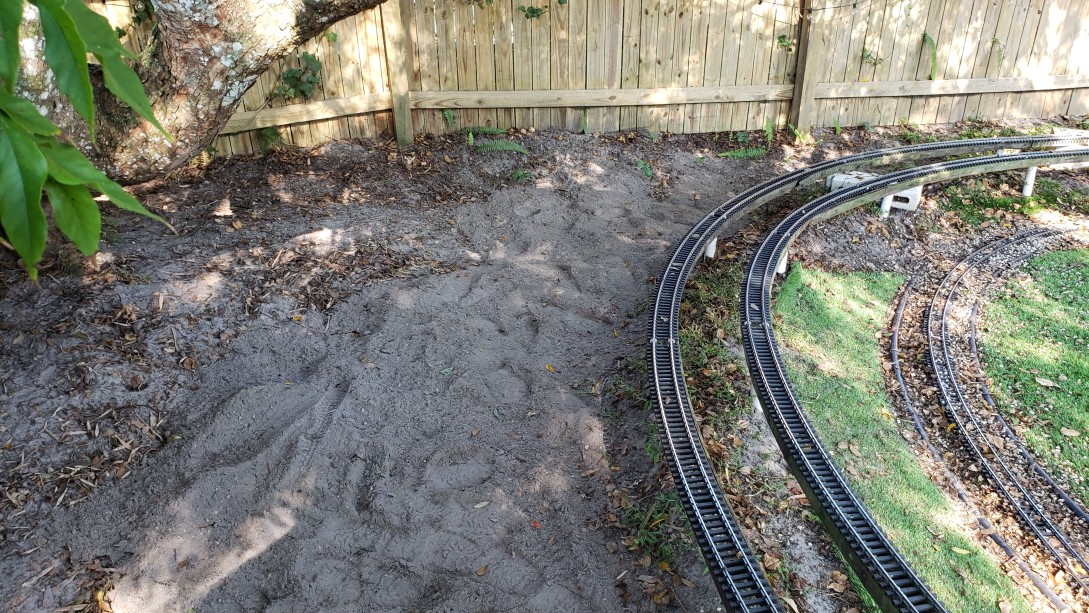
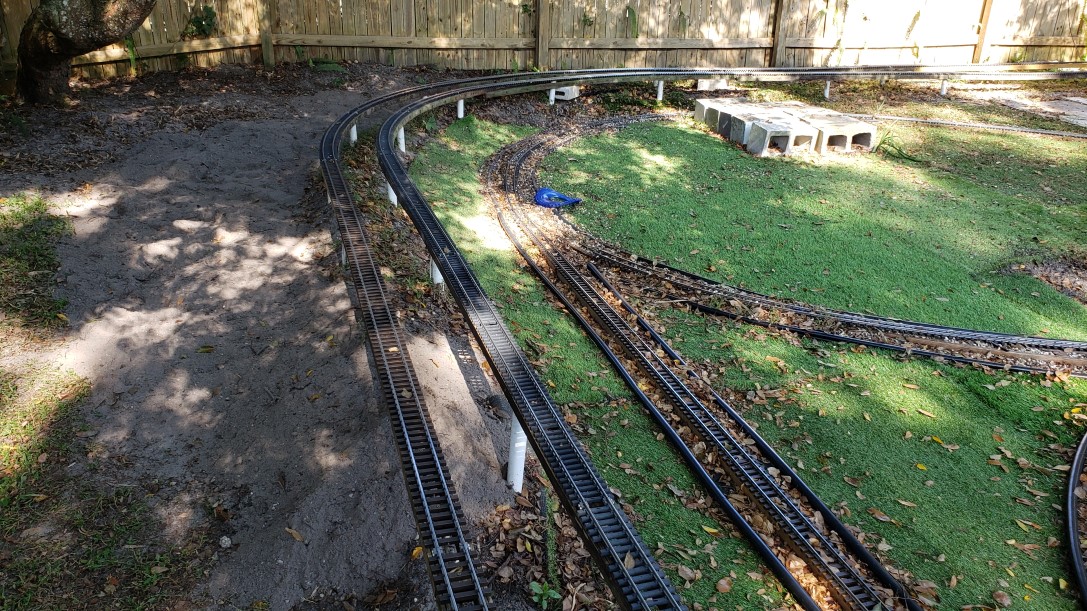
I’ve been slowly filling in the ascent from ground level along the back corner of the fence by the golden rain tree, but the grade still isn’t tall enough to meet the bottoms of the track stringers. Unfortunately, even though the stringers aren’t making ground contact, the “splash erosion” effect has covered the stringers with dirt, causing them to rot almost as quickly as if they had been…
I’ve come to the realization that “pressure treated” is just a marketing gimmick and has nothing to do with rot resistance. I could have used regular lumber and had the same results. Only after I constructed the entire railroad using wooden stringers, whose slats are cut from pressure treated 2x4s, did I discover cutting them renders the treatment useless!
That’s another story, but part of why we’re moving earth today. I’m hoping to add more fill so I can cast concrete in place of those rotted stringers. Something needs to be done, and quickly! Not only does Brigel knock the track loose jumping over it every time chases a squirrel along that back fence, but he also finds the latest stretch of failing stringer, snapping it to pieces!
Even though I’ve placed one prop after another under the bad parts, just to keep the railroad in operation, I find more damage every time I look. Irreparable damage that can only be remedied with a replacement stringer. An eight foot long stringer that requires the better part of a 2×4 to construct.
I’ve used copper napthenate treatment to coat all the replacement stringers I’ve built to replace the rotted ones, but the outcome of that experiment won’t be apparent for years. Time to try something new, like casting concrete. The thought is to make a nice looking set of arched spans that carry that stretch of trackage along the back fence, complete with a bridge over Main Street crossing beneath, and disappearing into the distance beyond.
This will eventually meet up with the earthen embankment to carry the rails around the corner and climb closer to the upper loop, which brings us back to moving earth. Even with casting concrete, I still don’t have enough dirt to climb up to where the bridge over the (future) water feature river and associated trestle work will go.
Mind The Gap
But that’s not the only place we need dirt! The space behind the curves in that back corner, between them and the golden rain train, has been trampled down over and over again by the dogs jumping over that section of track as well. In fact, the first three yards carts were placed directly in the “hollow” there. Kind of ironic that our son Nick’s pup, Klaus, is the reason we have all this dirt to move in the first place.
In the same way our pups displaced all that dirt, Klaus had banked the dirt up against the fence over at Nick’s place. Not all at once, but slowly over time, chasing the ball and planting to stop before plowing through the fence. Nick pulled all that dirt back away from it, going on a month ago now, the dirt having covered over the bottom runner in most places. While it was originally a single pile the length of the fence, it’s already been plodded over by Klaus and transformed into three separate mounds of dirt!
The grade was to high there, and every good rain we’d get would run straight down into the front of Nick’s garage, flooding it. Now there’s a swale of sorts between the fence and the drive leading to the garage, effectively carrying the water around the garage. So that’s the reason we’re moving earth today. Nick wants to be rid of it, and we want it.
We need it. We need it to fill in where the stumps of the trees we had removed were ground have now rotted and the ground sunken and settled. We need it to fill in along the path where Ann had put all those stones and it washed away the sides. Every time it rains here, we watch a little more of the Barkyard wash away beneath the fence and down the driveway.
These are upcoming projects, we’ve just been waiting on it to cool off here. When it’s still in the mid eighties in December, it’s a bit too warm for me to be out there swinging a shovel! The plan is to get the earth moved here, then we’ll figure out where to move it from there.
Moving Earth
When I still had my truck, we’d load whatever into the bed on top of one of those hand crank belts that’s supposed to easily unload by slowly moving it to the edge to of the tailgate and then fall out. We used it to move quite a bit of gravel to fill in the drive before finally having it paved. The belt worked with small loads, meaning we had to unload half by hand with shovels until the belt would finally slide along the slick Masonite we placed beneath it in the bed.
Well, two things wrong with doing that this time. First, I no longer have my truck, which the device was fitted to. Second, Nick’s new truck has a much different tailgate, and it would take too much to rework it to fit. That’s when the idea of borrowing our neighbor’s trailer started floating around in a discussion after dinner one evening. At first, I thought they were joking, trying to get a reaction out of me.
Nope. A couple days later I brought up the subject again, asking if they were serious about the trailer idea, and found out they were! The caveat is whether the trailer is up to the task or not. I agreed to have a look over it the next day, which I did. The bed had a plank replaced and it had already rotted into nothing. The remaining planks were dry rotted on the surface, but I felt still had enough strength to support the load with the help of a chunk of plywood to cover the gap.
So we planned on starting bright and early nine o’clock Saturday morning. I would see about getting the tires filled with air and we’d go from there. Well, best laid plans. I started the compressor right before Nick arrived… Turns out the hose reel will only reach the closest tire, and even then just barely, with a questionable valve stem. Thankfully Nick bought Ann a battery powered inflator for her car, just in case of a flat. It works like a charm!
The next hurdle is the hitch, and of course, the ball on Nick’s hitch is too big. Thankfully we saved the one from my truck that had the different sized balls still attached, but it was over at Nick’s. He had to run home to get it, but it fits! He left it attached to the hitch on the trailer and I wheeled it up to the receiver as Nick pinned it in place.
We already know the lights are shorted because it blew the fuses in my truck last time we tried to use the trailer! This time we know better, so I’ll follow Nick in my car to afford the safety trailer lights would afford other drivers if they worked. If also helps to avoid an accident should something happen in transit.
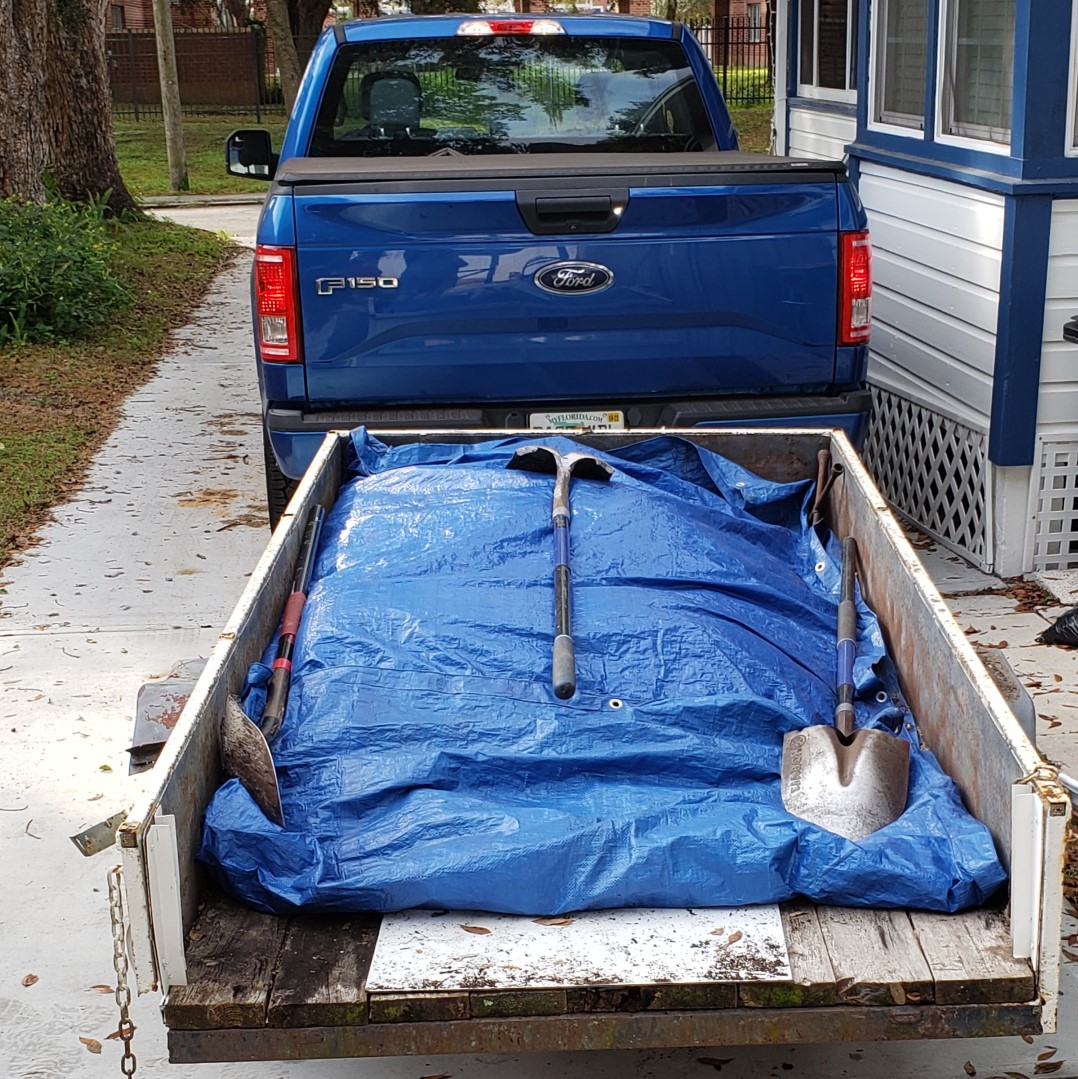
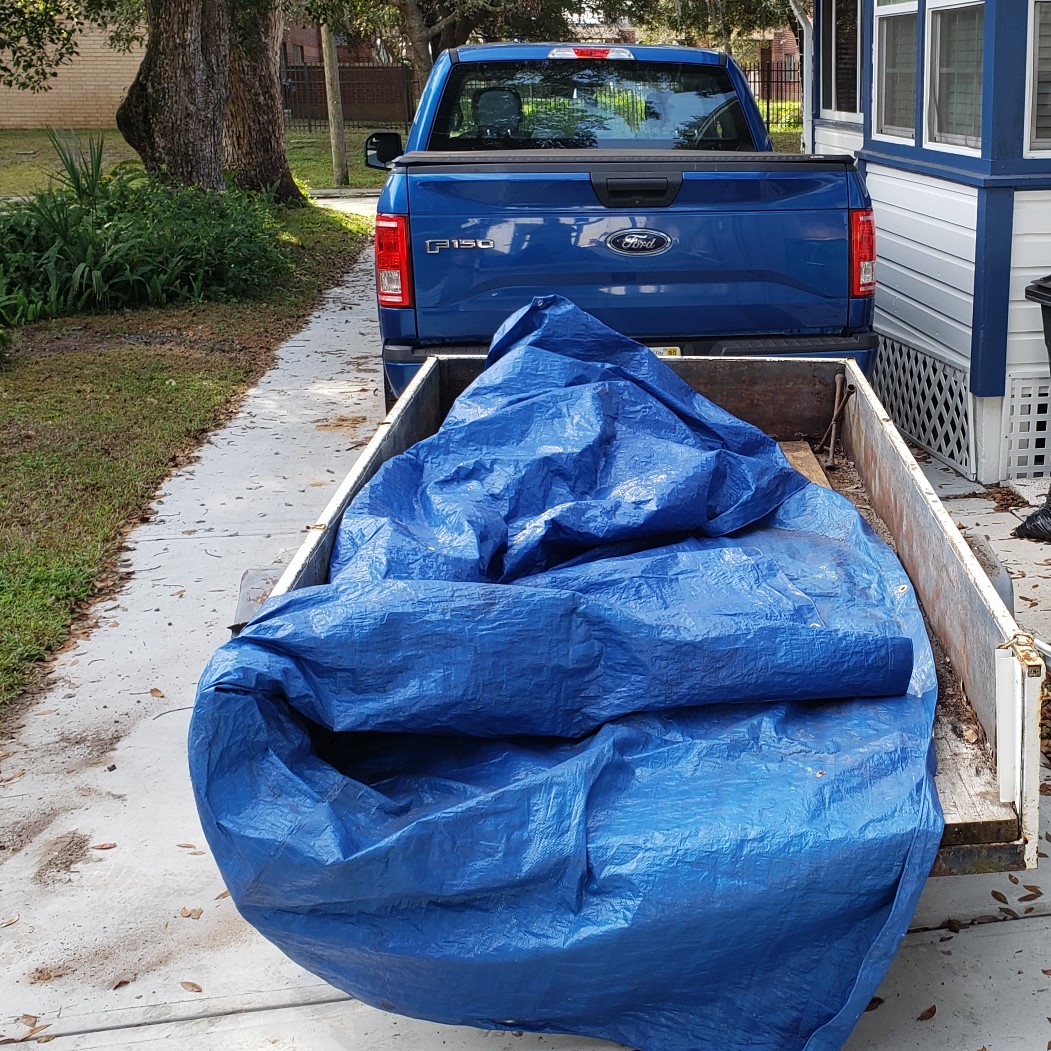
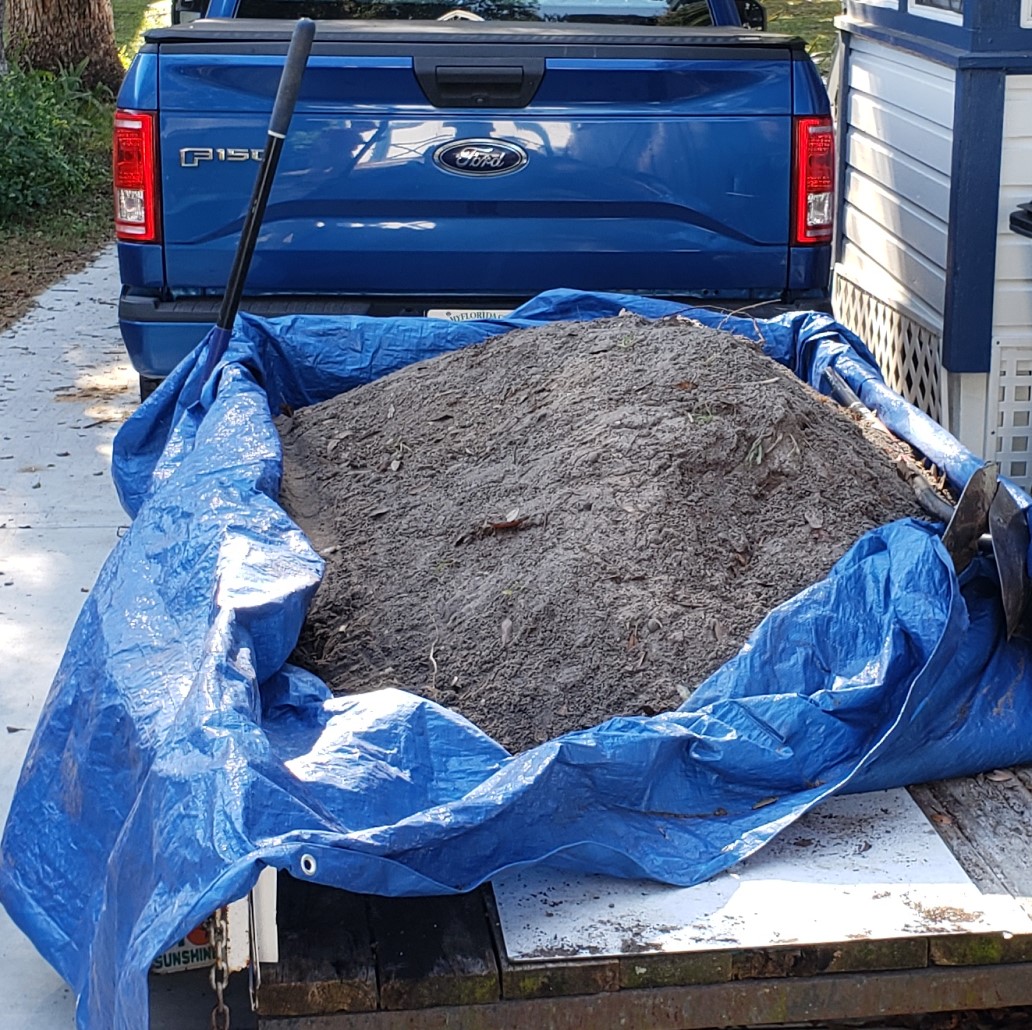
We get to Nick’s and he backs the trailer down the side drive to the first pile of dirt closest to the now open gates. Open now that he moved his car out of the way! We spread a tarp over the bottom to help contain and cover the load. The first pile goes on quickly, but not without a few breaks for me to catch my breath. We pretty much filled the trailer up to the sides and realized we had much more dirt than we first thought!
Two loads was looking more like four loads at the very least, but this one is loaded and ready to go. Nick heads out and as I’m backing out, some idiot comes flying down the street so I don’t have enough time to get in front of him… So Nick just stops, forcing the idiot to have to stop and go around him. I’m chuckling now, and I’m sure Nick has a grin on his face too. That soon fades a we begin to unload though.
Moving Earth A Yard Cart…
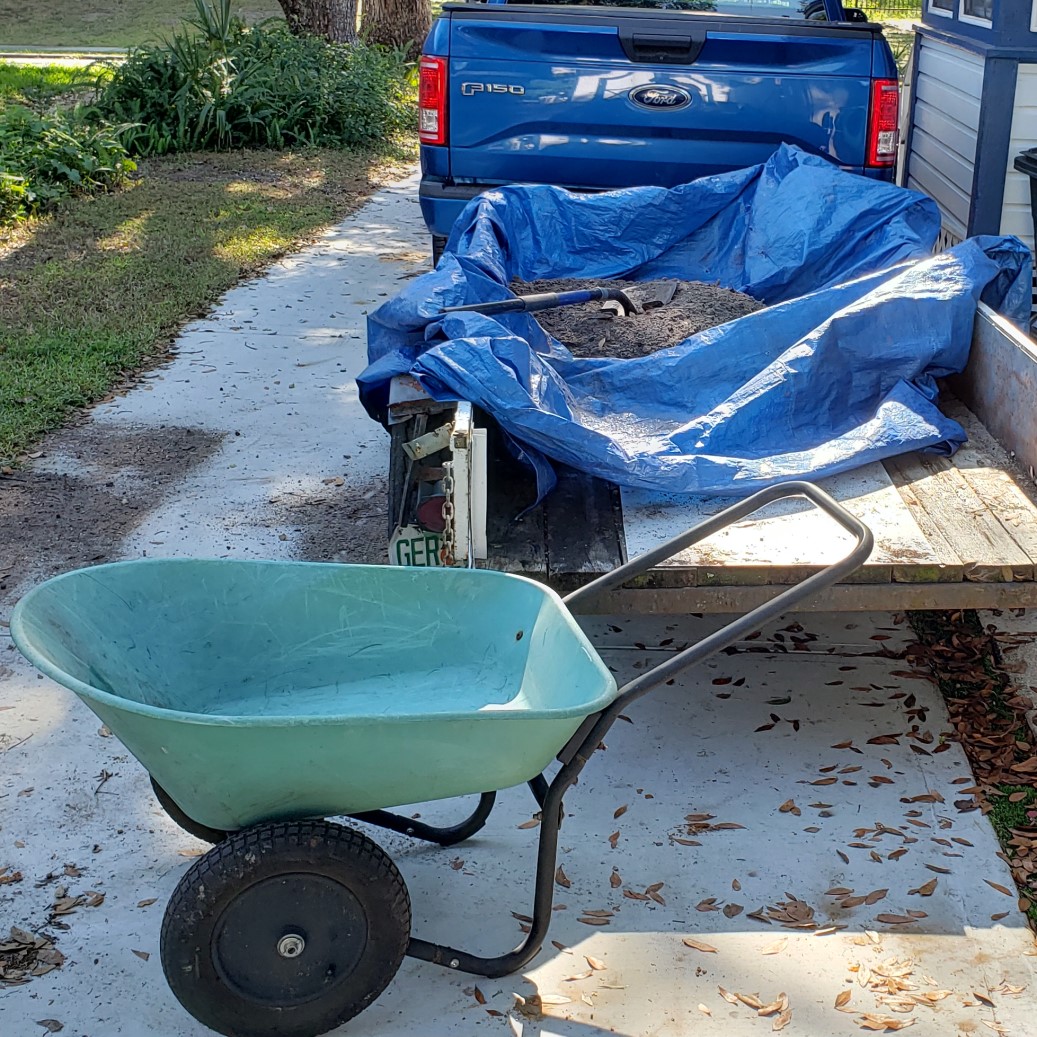
That’s right. It took enough to load this trailer, throwing a shovel full at a time in, but now it’s emptied a yard cart full at a time. Even if we could have adapted the unloading belt contraption to the trailer, only part of the load would end up in the yard cart, and only after emptying half of it by hand just so we could turn the crank. At first, it’s the two of us shoveling into the yard cart, then me unloading it where it went.
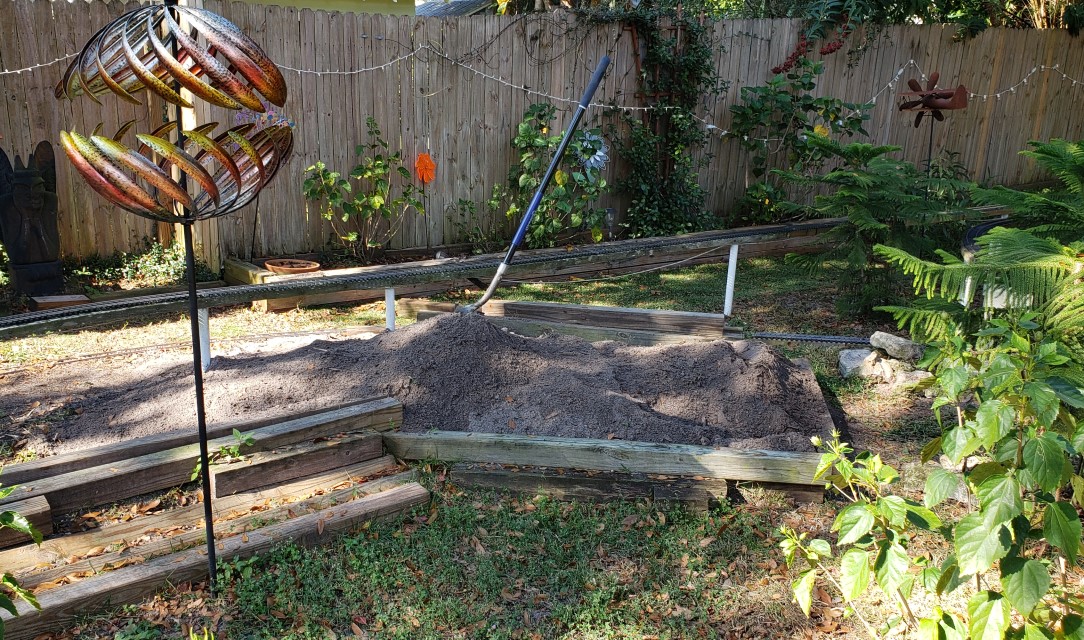
After the first few loads went straight into the hollow by the golden rain tree, it became more difficult to unload because now even part of the yard cart load had to be shoveled into position inside the upper loop. I nearly destroyed the track and the stringer trying to dump the half full cart over it, even after building a ramp with the dirt to help clear them.
Thankfully the trailer is empty before having to deal with it again. As we’re sitting there and taking a break, the idea of removing the bridge and just wheeling the cart through there is thrown out there. That’s it! It only takes loosening four of the rail clamps and it will lift right out of the way. Anything to make this easier.
There are roughly seven full yard carts worth of dirt in this first load. We’ll see if that holds true of the next load. I had just pulled up to the curb out front of the house, after blocking the street to give Nick enough time to back the trailer into the drive, but now I have to turn around just to follow him again. And once again, someone is zooming down the street to try to keep me from getting out… What is it with these idiots? Looks to be the same car too!
This time Nick is backing all the way into the yard so he can close the gate and let the pups out. They were asking to come out the first time, but the last thing we wanted was to have to chase them if they got out. I was getting the tarp ready for the next load when they came racing over to me. Nick says it’s the quickest he’s seen them race to or through the door. Well of course! It’s grandpa!
I give them the love and attention they seek, with Lena standing straight up on me and nibbling on my beard. It’s only takes a moment and they’re happy. I grab my first shovel full and right as I’m ready to throw it in the trailer Lena jump up in it! She’s lucky I saw it and stopped short or she would have been covered in dirt!
Moving Earth A Shovel Full…
This time we fill the trailer up past the sides, mounding it up to try to keep it to three loads if possible. It gets to the point that I have to stop to catch my breath after what seems like every shovel full. It’s not quite that bad, and the pups are a natural reason to stop, to love with them and throw the ball. After we finish and tire the pups out, it’s back to the Barkyard with the second load.
This time Nick has a hard time getting the trailer back up the driveway. I’m blocking traffic for him again this time, but it’s giving him fits after several maneuvers to pull up and straighten out. I had suggested he could just pull in, right up to the carriage doors, and still have enough room to unload and open the gate. Once the trailer’s empty, it’s nothing at all to unhitch it and move it so he can turn the truck around and hitch back up.
I’m guessing he’s wishing he did after all the fuss he went through. I can tell he’s not very happy. Maybe it’s too much like work for the both of us at this point. The unloading the first yard cart has me winded, but ready to go place it/ After wheeling it over to the dirt ramp I made and trying to unload it there again, I am reminded we were going to lift the bridge out of the way. DUH.
I grab the tool for the cap screws on the rail clamps and get busy removing the bridge while Nick shovels another cart full of dirt. I wheel it over the track and stringer that runs along the front of the bridge, but decide I need another dirt ramp to ease the transition. Nick is off loading another cart while I’m spreading out the dirt and making that ramp.
This time Nick is able to roll it over the stringer an dump it while I pull some of it back and away from it. I’m definitely winded and need to take a break after this though, I tell Nick I might have one more load in me… Thinking we can get the rest in one more load and more more big push.
The next load has me once again dragging a few shovels away from the pile, then resting to catch my breath. A few more and another break. I reiterate I might have another load left in me. By now, Nick is sitting down to take a break while I handle unloading another cart.
We’re both getting slower and slower as it gets to be after noon. I lost count at eight carts, but there’s still more left on the trailer! Nick is out of steam and needs lunch before he can do any more, so he and Ann head out to grab us some lunch. I take the opportunity to set the fan on high and sit under it and cool down. It’s taking them longer than expected this time, but they finally make it back. It tastes even better than I imagined, so I must be hungry!
After Nick unloads the last of the dirt, he calls it quits. No more today. We’re done. While I’m disappointed we won’t be finished today, I’m more than happy to be done for now! He unhitches the trailer and tries to move it back where it where it sat, but I can tell he’s tired after multiple tries and he’s still not close. I take over for him and he heads out while I try spreading out the dirt inside the upper loop in the manner I first envisioned.
The Vision
We want to restore the pleasant view of the waterfall, but it’s going to take time to get a “self maintaining” water feature installed. Until then, we need a reason to have a waterfall. One that looks like a natural, abrupt change in elevation. The original idea was to build height in a terraced fashion, one 4×4 at a time. The first step roughly 3½” deep. The next 7″. Then 10½”, 14″, etc., eventually reaching the 20″ height of the trestles supporting each end of the bridge.
But I don’t think Ann quite understood where I was going with that and promptly planted a bunch of Azaleas along where the first step of the terrace was supposed to start. They’ve been there long enough that the dogs have killed off a couple over the years, but those remaining still grow and bloom like crazy. They’re part of the landscape now and removing them would remove the view block they provide for what’s behind them… DIRT!
So the modified version is still terraced, but lowering the target height by rearranging the track layout. The current upper loop arrangement has two tracks at about the same 20″ height off the ground. If we modify the arrangement such that one end passes over the other, then one end only has to clear the new lower loop by 8″. That gives us nearly an entire loop of 20′ diameter track to gain another 8″ clearance we’ll need to cross over the other end.
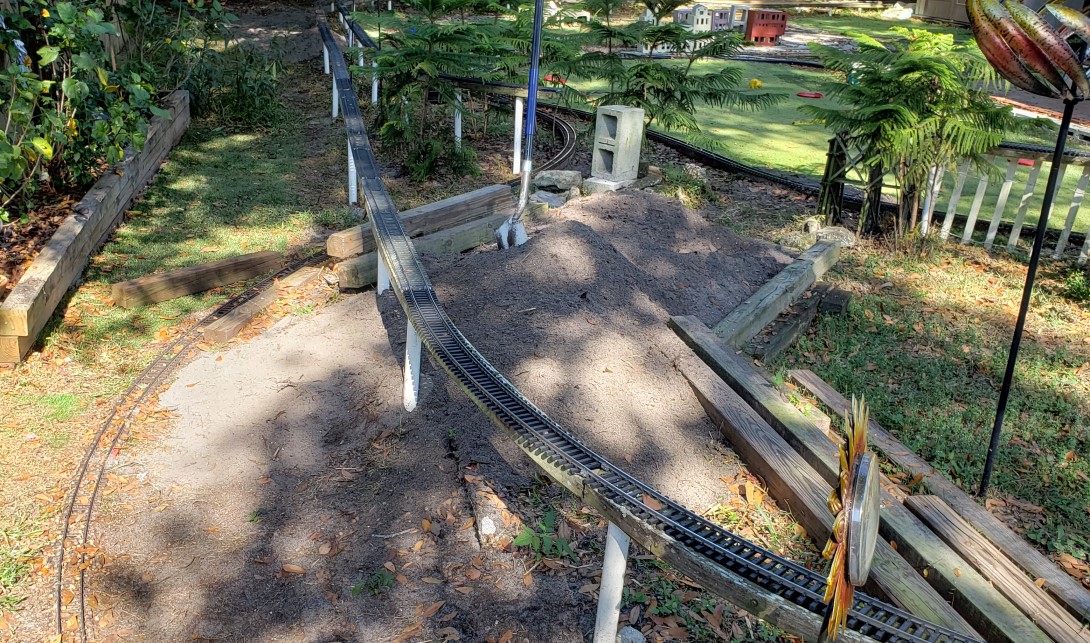
Essentially only one of the two tracks that ascend to the upper loop need to ascend as high off the ground as they do now. The other can level off and run beneath the other, but over the new lower loop beneath. It will be an eye catching arrangement, with the a bridge over a bridge over another bridge over the “river” below. I have some design work ahead me before that happens. The “Mount Crumpet” picture below shows the bridge removed and the two ascending tracks to the upper loop.
And I have some really bad trackwork that needs repaired before any of that. Add a new Main Street and more downtown buildings and it starts to push things out quite a ways into the future. I think we’ll start with getting that optimistic last load of dirt over here. That isn’t happening next weekend, and the following weekend is Christmas. I was hoping to get some semblance of a Christmas train working this year and Christmas decorations for downtown, but it’s looking more and more like I’ll be lucky to have any Barkyard decorations at all, 1:1 scale or otherwise!
We’ll keep this updated as we make progress. Stay tuned!