Concrete Roadbed – Trial Version

We finally threw in the towel! Using wood stringers as a roadbed is just not working out. It’s been one thing after another using wood. The first setback was rot. We finally found the answer to that, but the next thing was keeping the track fastened to the stringer – with a couple puppies constantly pounding on it. Even adding screws every 8″ didn’t help! We now have track with much larger holes in the ties where the screw heads pulled through them.

Fast forward. We’ve added yet another puppy to the team, Jasper. Alright, three full sized German Shepherds! None of them are little puppies anymore. We were barely keeping ahead of things with two puppies pounding the track into the ground. But now we’re fighting a losing battle with three, we’ve been removing track, not adding it. And that’s moving in the wrong direction!

Concrete roadbed should certainly hold up to the constant pounding, if sidewalks and driveways are any indication that is… Beyond that, the idea is to shape the concrete with a center depression, a “well” of sorts, that will “cradle” the track. The question now is how deep of a well and how to screed and shape the concrete. A picture is worth a thousand words.

SketchUp Model
Cast in place or cast bricks? How Deep?

Choices

There are two choices that must be made. The first is whether to make the well as deep as the track and the ties are tall or only as deep as the ties. The second is whether to form the roadbed then screed the well into the freshly poured concrete or cast “bricks” that can be placed independently once cured. At the bottom center of the above diagram is the deep well profile “screed tool”, with the “only ties deep” version to the right of it. Above them are the “bricks”, along with some dimensions. That particular set is designed for 20′ diameter curves.

Let’s start with a continuous formed pour with a full depth well. Had we known how much work… Well, the work to “trench” out where either the forms or the bricks will sit is a wash, but the forms themselves take days to “perfect”. Essentially we want the track to be about flush with the terrain. That requires a thickness of at least 1½”, with roughly a ¾” deep well down the middle. It may not be readily apparent, but the profile we’re shooting for has a taper at the top, away from the well, to simulate a prototypical ballast profile.

Getting Started

But before all that, we need to cut out a stripe in the artificial turf roughly 6″ wide that follows the path of the existing wood stringer first. The Dremel saw with a plastic “blade” makes fairly quick work of that task. The before and after shots show the recent relocation of the lower loop track, sitting atop the turf, and the new path awaiting installation of the forms.

Relocated Lower Loop Before Cutting Turf
Lower Loop Track After Cutting Turf


You can see a start of staking out the forms using the 2×6 roadbed pieces we used to “elevate” the new middle loop track up off the deck. These are a perfect fit for spacing apart the ¼” thick x 1½” tall slats we’re using, attached to 8″ stakes “strategically” driven into the ground. This is just a test fit of sorts. The track is roughly at the desired height, but the forms need to be installed lower such that the top of the rails is even with the tops of the forms, a difference of ¾”.

After filling a yard cart with the dirt removed along the 10′ stretch we’re pouring concrete into, the real work of installing the forms begins. It’s taken a day’s work to get this far. It takes another day just to get all the stakes driven in the ground and the slats bent into shape. And yet another day to attach the slats to the stakes! It’s all adding up… Three days for every ten feet of roadbed means it’s going to take forever to replace the exiting wooden roadbed.

Finally Ready To Pour Concrete!

Regardless of the time spent getting here, we’re finally ready to pour concrete, starting with mixing. The directions call for 3 quarts of water for the entire 80# bag. Despite using one of the measuring buckets to dispense three quarts exactly, the mix is too dry. Adding another quart results in a mix that’s still too dry. Not quite another quart and now the mix seems too wet. At this point, I’m winded from all the mixing by hand using the shovel. It doesn’t help that I’m using the small mixing tub, which is obviously meant for 60# and not 80#.

After shoveling about three feet or so into the forms, I try to screed the profile using the 3D printed tools, but they’re just not working. It seems the tools would have been better designed like trowels to better float the profile into the pour. The tools are crudely scraping the profile more than smoothly forming it. Even working the tool back and forth like a simple screed board doesn’t seem to do much better.

So far this seems like a losing battle. By the time the entire ten foot length is poured, the only thing that worked as planned was the amount of concrete needed. I’m more than a bit discouraged by the outcome, but way to exhausted to do anything more than cover the fresh concrete to keep the pups out of it. We’ll see how it turns out tomorrow when we can remove the forms.

Ready To Remove The Forms

The picture tells the story. It’s obvious that the profile we were looking for did not materialize. It’s a crude approximation at best. Thankfully the track does fit in the well, but not very well. The sides that are supposed to protect the track and hold it in position are crumbling at the slightest touch. Removing the forms breaks large chunks of the sides loose. Not a good first impression to say the least. By now the meaning of trial version is apparent…

Stay tuned for more updates. A change in plans is definitely called for though.

Merry Christmas 2023!

Merry Christmas and Happy New Year!

From All Of Us At The Barkyard Railroad…

We wish you all Happy Holidays, Merry Christmas, and Happy New Year!

While it may not show all that well, we’ve been busy here, working on the railroad! And while it may not be working on the railroad all the live long day, we’ve been busy planning and doing, just not reporting and updating. If we make just one New Year’s resolution, it’s to report and update more often! So with that in mind, here’s what we’ve been up to this last year, 2023.


Our Deck Has Decking!

(Feb/Mar 2023)

And railings! And steps! And that’s about it for now. The deck project is at that “add a little bit here, add a little bit there” phase. The next big push will be adding utilities and the tunnel(s). Trenching in the utilities doesn’t require much planning. The rest will take more “Imagineering” as the mouse down the road would say.

The reason the deck exists is to provide easily attainable elevation change. Them’s some big words there! What did he say? Mainly we didn’t want to have to move and maintain all the dirt it would take to build believable mountains and tunnels. So now the “imagine” part is how to make that last corner of the deck look like a believable sheer wall and somehow wedge a grist mill’s water wheel into a water feature as part of all that.

The second tunnel would be arranged around the hand rail of the steps, basically to hide the stairs from view altogether everywhere but standing in front of them. It needs to provide a believable reason for the lower loop and deck loop to exit tunnels by the terraced planters. We have electronic (CAD) drawings, but they don’t provide the “hands on” experience that fitting various pieces together with a creative eye. More to come.


Adding A Split Unit Air Conditioner

(Mar 2023)

The office was always on the warm side, always much warmer than the rest of the house anyway. Not anymore! Finally pulled the trigger on a split unit air conditioner / heat pump to better regulate the temperature year round. Much thanks to our son, Nick, for the unit selection and help with installation. We couldn’t have done it without him!

The Barkyard workshop had one installed a year or two back when the window unit air conditioner finally died. Nick gave us his old unit when he installed a new, more capable one in his workshop. All we had to do is buy more refrigerant to recharge it. While the window unit ran all the time and still couldn’t keep up in the summer, this split unit not only keeps the shop cool in the Summer, but also keeps it warm in the Winter.

That window unit is still sitting in the window! Eventually it will get replaced with a new window, but for now, there are far more pressing issues. For now, the office has all the comforts the workshop affords. The only thing missing is the smartphone app to remote control it. Not sure what happened to the little QR code thing to scan and install it, but it appears to be impossible without it. Again, more pressing issues…


Trenching In Utilities To The Deck

(Apr 2023)

The next step for the deck is adding utilities, namely power and water. Power for all those gadgets we’ll soon have installed. Water for irrigation and future water features. Nick lent us the “banana” shovel to make the job a little easier than using a standard garden spade. Even so, it still took moving ten yard cart loads of dirt just to reach the middle of the deck!

Well, that and moving a few pieces of artificial turf out of the way first, removing the rusty old “staples” and all. The first day got us half the way there to the near corner of the deck, roughly ten feet, or one stick of pipe / conduit. But we can’t just leave an open, narrow, two foot deep trench for the dog to fall in to and injure themselves. So we back filled the path and covered it with the turf just to be safe.

The second day we trenched the last ten feet to the middle of the deck. Gluing the next ten foot legs of all those pipes and conduits down in the trench was no fun, and not all at once either. First the conduit was finished and buried at the foot and a half mark specified by code, backfilled to half a foot deep to finish the irrigation lines. Once those were completed, the entire trench was then backfilled and compacted.

Two of the irrigation lines remain to be extended to the far end of the deck. but that’s another ten feet to trench, albeit only six inches deep. It’s a project for another time, twenty feet is good enough for now.


Welcome Jasper!

(May 2023)

Meet our latest addition to the crew, Jasper! He’s our focus now. Getting him crate and potty trained didn’t take long. And just like with toddlers, all the things that aren’t good for him to get in to have to be hidden and locked away. And he gets in to everything! After all, he is a puppy!

He’s getting used to his brother, Rocket, and sister, Kai, and new yard, the Barkyard. Kai took to him almost immediately. She’s already playing quite rough with him, getting him just mad enough to bark at her and jump up to fight back. It’s heart warming and comical to watch all at the same time.


Deck Railing Updates

(May 2023)

The railings on both sides of the main deck have been attached for months now, but attached with a minimum of balusters. While the deck isn’t tall enough to require railings at all, we still want them, but mainly for a place to set down a drink or plate of food or whatever. Without more balusters to provide adequate support, they don’t even provide safety.

The balusters themselves were provided by Nick, and used to support the railings around the deck for his above ground pool, now long gone. I’ve moved them here and there and everywhere out of the way while waiting to use them. They sat outside long enough to warrant an anti rot treatment, and then needed cut to length for sitting height and not standing height railings.

They’ve been stacked at the corner of the deck, awaiting installation, until now. If required by code, they need spaced no more than four inches apart. Since they’re not required, we attached one per plank at the joint between planks, not quite five inches apart. Close enough.

The railing itself is a deck plank, but the final touch is to attach another one to form an “L”, which provides that shelf to set things down on for both railings now.


More Stringer Repairs?

(May 2023)

Yeah, I know, don’t say it. Wood is NOT the correct choice for stringers in Florida. After yet another round of stringer replacement, we turned to using the “plastic wood” 2x4s waiting in the workshop for just such an occasion. While they may last longer outside in the elements, they certainly take longer to cut! The feed rate is about half that of a wood 2×4.

Add to that the plastic “shavings” are statically charged and constantly clog the vacuum hose to the shop vac. Having to stop after each and every ¼” thick slat to unclog the vacuum hose means it’s taking twice as long to cut each one, and these are only six foot long to boot!

Considering what a major pain it was to cut just these three 2x4s, this is probably the one and only time we’ll consider using them. But at least we tried. Live and learn. Moving forward, ground contact stringers should be concrete and above ground stringers will eventually be replaced with trestles.


New Equipment Added To The Roster!

(Jun 2023)


The Barkyard Railroad has recently acquired three six axle EMD SD40-2s in the PRR Brunswick green livery. All three units were put to the test on the pike! A dedicated run in stand was constructed to test them out prior to mainline operation. And by constructed, we mean 3D printed and assembled using only the least expensive roller skate bearings available. This latest set of twelve rollers pretty much used up what was left of our stash. Even the M2.5 screws and nuts are getting scarce! So we ordered another 100 bearings and 200 SS M2.5 screws and nuts.


In addition, we added a New York Central S4 switcher, several 40′ boxcars, a couple of 50′ boxcars, and a New York Central Caboose to the roster as well. The S4 switcher set included a new 4 amp power pack, with enough juice to run those bigger engines and the switcher all together at the same time!


But we didn’t stop there! We needed cabeese! Alright, cabooses. We added three center cupola wood sided units, two in PRR livery and one in Rio Grande. We didn’t have a single PRR caboose to go with the new SD40s, and needed something to go with them. Thinking of “kitbashing” one of the two PRR units into an N5C “porthole” unit. Maybe even both if it turns out well!


Irrigation Lines Extended

(Jun 2023)

When the utilities were trenched in to the deck, they stopped at the halfway point, mainly because extending them any further meant removing some of the decking planks to gain access beneath it. Because of the angle change it makes at the midpoint, the far end and corner would overhang an extension of the straight line path the trench follows.

But until those irrigation lines are extended, any further work on the deck is on hold to avoid having to “back track”. So two of the three lines were trenched just past the far corner of the deck. They will provide for any water features and, eventually, irrigation for the raised beds along the fence. One of those two is meant to terminate there at the corner of the deck and has a permanently installed riser. The other was not glued together, but has a temporary riser in place until the raised irrigation line is trenched in some time in the future.

The third line was terminated near the middle of the deck with a permanently attached riser. This line is dedicated to irrigation for the terraced planters.


Surveillance Camera “Upgrade”

The original camera that essentially looks out from the beneath the office window worked for a limited time then failed. The camera was fine, but the Power Over Ethernet (POE) cable connection wasn’t, a number of the contacts badly corroded despite the weathertight sealing components. It sat, waiting to be rescued and revived.

That POE cable used to run in through the office window, preventing the sliding parts from closing completely. Everything about that camera was an afterthought, temporary by nature to begin with. It served its purpose, albeit for a short time only.

With the new split unit, a dedicated pass through was installed dedicated to its power and plumbing. That pass through can now be shared for a more permanent installation of new cables. That’s right, plural, cables. Because we added a new camera to keep an eye on the new split unit, watching what used to be a blind spot between our house and the neighbor’s.

We also replaced that camera outside the office window with a new one because it looks like when it was opened previously to inspect for damage, the weathertight seal was lost and it corroded parts of the circuit board. It still works, but it’s sitting in a drawer, waiting to be pressed into service for any interior use for which it may prove useful.


Running Trains For the Fourth Of July!

(Jul 2023)

We ran the new S4 switcher together with some of the new boxcars and the new Pacemaker Caboose. Jasper had a blast barking at it and chasing it around and around! He’s so much like his brother he never met, Brigel. It was enjoyable sitting in the rocking chair on the new deck, watching the train run around the layout with the puppy in tow. We switched out the switcher for one of the SD40s. Then two of them together.

The track has been ready to run for awhile now, the only thing missing a more permanent solution for a “step over” to remove the tripping hazard created by the track right near the edge when stepping on and off the deck. It’s only a few inches tall, but enough of a tripping hazard without something more substantial in place for safety. The idea is create something like a threshold, like in a doorway, substantial enough to be stepped on.

Eventually we’ll make it like another step at the top of the steps, but for now the “slotted” 2×6 segments will work just fine. Adding a hand rail for the steps will provide more safety as well as provide an anchor point for the “mountainside” to hide the fact the track is a simple loop. But more on that later. It’s a 2024 thing now.


Sidetracked By Leaking Air Conditioner / Kitchen Teardown / Rebuild

(Jul 2023)

Sour grapes. So much for paying “professionals” to do their job correctly, let alone finish the job! Imagine discarded gloves floating in a bucket of trash left in the attic. A bucket left in the attic to contain the leak they obviously knew about and just left that way instead of doing it right. Left there since they installed it Last December (2022) and left before they were finished. Well, that bucket finally overflowed and totally saturated the plaster and lathe of the kitchen wall below. Pictures are worth a thousand words. Pictures yet to be posted. Enough said.


Realigned Track For Water Feature

(Aug 2023)

In anticipation of adding a water feature in the future, we had to realigned the track that follows the lower loop around the deck. More like the exit of the loop toward the wye and downtown. The path it took, not quite two feet away from the trees was entirely too close to allow for an adequate creek channel, let alone river.

With a yardstick in hand, a radius is swept from the nearest object is a curve from beneath the bridge toward the fence, describing a tight river bend for the track to follow. The idea is to have the track follow the bank of the river / creek / stream to give the track a reason to curve in the fashion it does.

We were dreading this because of how difficult it is to cut the turf, and put it off again and again, until one day we though about using the dremel saw in place of the awkward razor knife we’d used in the past. Talk about a world of difference! Not only does the dremel saw slice through the turf like butter, it melts the edges together, eliminating those inevitable “carpet strings” when using a knife.

Of course, it doesn’t hurt that the rotted stringers beneath the track need removed and replaced anyway.


Decking Trimmed and Another Railing Added

(Oct 2023)

With the utilities trenched in for months now, we need a place to attach an outdoor in use electrical box to allow easy access to power. The problem is there isn’t a convenient post to mount it to, or anything else for that matter. The thought is to add a post where the two parts of the deck meet at an angle, but the decking overhangs the framing, making it impossible to mount anything to the framing.

The railing is missing from that part as well, and for the same reason, it’s impossible to mount the balusters to the frame. Time to do something about that. A quick trim with the circular saw and problem solved. There are just enough screws to attach the balusters and railing, but not enough to add the top cap. We’ll need to get some big lag screws to attach a 2×4 or 4×4 to the intersection between the two parts of the deck for that electrical box mount though. It’s a 2024 thing as well.


Preparing To Cast Concrete Roadbed

(Nov 2023)

All preparations are made for installing the forms to cast concrete roadbed beneath the stretch of track we realigned back in August. We 3D printed screed tools with the edges sloped away from the center depression meant to cradle the track, one just tie depth and the other the entire track height deep. We’ll see which works best, if at all. I took the week of Thanksgiving off with the idea I would be working on the roadbed. Plans change…

Some distraction away from making progress toward our goals always crops up, like the kitchen disaster. At least this time it’s not a disaster. The kids have been dealing with the lack of a water supply line to their refrigerator’s ice maker for some time now, basically ever since the the plastic water line in the attic failed and nearly destroyed the kitchen there. It’s been useless ever since. Literally years now.

As a Christmas present, we tore the outside wall off the back of the garage and ran a new pex line off the old copper hose bib feed. Too many trips to get parts later and it’s installed and operational. Can’t say that much about getting the garage wall siding back in place and painted though. We did manage to hang new ½” plywood sheathing to protect it from the elements, but like everything else these days, the one specific kind of siding we need is no longer available? Yet another 2024 thing.


New Equipment Added To The Roster!

(Nov 2023)

The Barkyard Railroad has recently acquired an LGB 20882 Uintah Mallet Steam Locomotive. The invoice says “Collector’s Item”. It’s priced like one, that’s for sure! Even the few Bachmann versions I found are fetching a high price! Back when we were first looking to start a garden railway at the other house, the Bachmann versions were plentiful on eBay, and for a third the price being asked these days.

I had always wanted one, but figured they would remain just as available as they were back then. Wrong! They were no longer available for any price. Every so often I would search again but still found nothing. As luck would have it, I received an email from Only Trains (not sponsored) which included some used items for sale, including this recent addition to our roster.

Every email from every other online hobby stores that include used items for sale are already sold by the time I look. I didn’t get my hopes up, but looked anyway. Much to my surprise they still had it! A quick search on eBay turned up a few Bachmann versions, and all around the same price! Considering none of those had sound already installed like this LGB unit did, I jumped on it right then and there.

Of course, it requires its own run in stand. Four 3D prints and a bunch of screws and bearings and assembly later, I have the 16 roller stands I need. It’s also the first and only time I needed to run power through the roller bearings themselves. I chose to only run power through a pair of them since it’s not the best thing for them.


Lithophanes

(Dec 2023)

Buying and exchanging gifts with loved ones is a Christmas tradition. But there’s something to be said for making the present for a loved one oneself. Something that isn’t really commercially available. Something that comes from the heart. Something that is close to your loved one’s heart. In this case, two such close to the heart items.

So by now you’re probably screaming, “What’s a lithophane already?!?!?” It’s hard to describe, another picture worth a thousand words type thing, but let’s try anyway. Imagine a 3D printed black and white picture, using a somewhat transparent filament. More like translucent, but the idea is the thicker the print, the less light makes it through it. More light makes it through the thinner portions. So necessarily a strong, diffuse backlight is required to illuminate the print.

I liken them to one of those illuminated photo cubes of the past vs. those new fangled digital display cubes that cycle through a set number of stored images, except using a more three dimensional rendition of the image. The backlighting comes from an array of LEDs, but they appear as point sources and are too harsh without a diffuser, in this case a thin 3D printed piece using white filament.

The only thing missing is the picture frame to “stuff” everything inside. I started with a site set up to generate the actual STL of an uploaded image file. It also had STL files for the frame and diffuser, except I didn’t read the instructions and uploaded non standard sized photos which resulted in something that was not exactly 4×6 and didn’t fit their 3D printed frame. So that was a bummer. It also meant I had to do more work and design different sized frames for the two pictures I used. The end results are well worth it though.


New Equipment Added To The Roster!

(Dec 2023)

The Barkyard Railroad has recently acquired an A-B-B-A set of F7s in the PRR Tuscan livery as well as ten heavyweight passenger cars in the same Tuscan livery. Basically one of each of the available cars. These cars are each nearly three feet long! They include figures and flicker free lighting already installed from the factory. They are truly impressive. And they better be for as expensive as they are!

Of course, the F7s requires their own dedicated run in stand. Three 3D prints and a bunch of screws and bearings and assembly later, I have the 12 roller stands I need. So now the office and the bedroom are full of USA Trains boxes full of equipment we won’t be able to run until 2024. Thankfully, that’s tomorrow. Happy New Year!

 

Spring 2023 Infrastructure Improvements

Big Enhancement To New Upper Loop

The Battle Continues

It goes without saying there are even more stringers in need of replacement! It’s been difficult to keep up with only weekends to effect repairs. This says nothing about new additions or improvements so far. More stringers. Ugh. It should be obvious from that statement we have yet to get to any casting whatsoever. In fact, we’re actually moving in reverse, removing track the dogs have knocked loose from the stringers, just hanging off the sides.

We had to put up “blockades” on either side of the shed to keep Kai from bounding on, and potentially breaking through, the fence. Unfortunately, she’s pounded those 10′ diameter curved stringers to pieces, literally. It’s the only place I’ve yet to remove the track where it’s hanging. In fact, there are at least two more stringers that need replaced to make that deadline and another section in need of repair as well.

I’ve had a set of “plastic” 2x4s standing in the garage for years now, with the intention of using this material to construct stringers to (hopefully) last longer than any made from wood. I call them plastic, but they’re actually a composite of wood and plastic. I ripped the three I had into slats last weekend and got the 10′ diameter curved stringer template out of mothballs in the shed.

What’s Left Of The Curved Stringers
New 10′ Diameter Curved Stringers


I have to say I certainly hope they last longer than wood because they are especially more difficult to rip into slats than their wood counterparts! They don’t really make much “sawdust”. Rather, they create many small shavings that want to clump together, clogging the vacuum in the process. Not sure what make them want to cling to each other, but what a mess! Don’t think we’ll be using this stuff again. The PVC siding I used to replace the bottom course of shiplap didn’t make this kind of mess, so I was surprised.

Our New Deck

Like last year at this time, we’re shooting for running trains Memorial Day weekend. There’s still quite a bit to do, and the stringers aren’t the only repairs that are need. The constant pounding by the pups has once again destroyed the two curved legs of the wye. One rail will need bent back to the proper radius and made flat with the rest of the track. While I’m reluctant to just put them back in place, for now it’s the only way we’ll be running trains by the weekend, even with Friday and Monday off work.

It’s a bit disheartening seeing a stack of track sitting on a rocking chair on the patio and all those stringers we replaced with no track attached. It’s been months since we’ve been able to run trains. But all this doom and gloom is balanced by our deck project. The deck is coming along nicely and nearing completion. The deck is actually part of the road bed for the new upper loop! It’s a cozy place to be, surrounded by trains as they pass. At least that much is nearly complete.

Our Deck Is Coming Along Nicely

We still need to work out how to craft the short tunnel section where the lower loop passes under the middle section and meets the deck. For now it’s just makeshift stacks of concrete blocks and decking “cut offs”. We decided not to extend the deck all the way to the planters along the fence to leave ample room for the dogs to run and chase each other. Kai can really fly when she’s chasing those pesky squirrels!

Along those lines, we’ll need to figure out some other means to blockade Kai from behind the shed and accommodate running trains. We’re thinking some sort of tunnel entrance on one end and perhaps a giant industrial building facade with through passage beneath. I don’t recall what prototypical building this represents, but I do remember seeing one like this somewhere. At this point, anything will looks better than the chunk of plywood and section of fence we’re currently using, neither of which will allow trains to pass.

Other Improvements

As part of the deck improvement, we’ve added an underground power feed and a number of irrigation lines out to the deck. It’s a start anyway. The idea is to get the trenching done and out of the way before we continue to add more dirt to the planters that back up against the deck, to avoid having to move it more than once. It took several weekends to accomplish, starting with the first ten feet from the house to the edge of the lower loop.

Actually, it passes just beyond the lower loop, but that first ten feet is where the dogs like to chase each other around. We want to make sure it’s backfilled so when the pups play they won’t get hurt. The first four feet is basically just pavers out from the house, so the most difficult part was moving the dirt elsewhere rather than piling it on top of the pavers. From there, the next five feet is covered by artificial turf that we pulled back out of the way, and now a tripping hazard.

Banana Shovel Nearing The 10′ Mark

Even using the “banana” shovel, a long and narrow shovel meant for trenching, it takes into the afternoon to get down to 18″ deep for the conduit. Once the conduit and elbows are glued up and placed into the trench, it’s backfilled and compacted to about 6″ deep for the irrigation lines. Three of them, to be exact, basically ¾” PVC to support multiple irrigation zones. Those are backfilled as well to where the turf can be laid back down to cover the path.

Not sure what happened with the stretch of conduit at the house up to the outdoor in use box. It measured 44″, then fell short by 4″! You’ve heard “Measure twice, cut once”? Try “Measure thrice, cut twice”… It’s not that big an issue, just means it will need a splice before landing it in the box is all. For the irrigation lines, they stop short of going under the deck, mainly because some of the decking will need removed to gain access beneath in order to finish trenching.

Future Enhancements

Obviously we need to finish up the “utilities” to and around the deck. The conduit and irrigation lines now extend to roughly 20′ from the house, but remain unterminated. Unfinished. Most of those improvements will be covered in the deck series and not here. Eventually the conduit will feed power for lighting and other features on the deck. The irrigation will split out in “T” fashion, one leg heading to the planters along the fence, another toward the other planters along the other fence by the garage, and the third will feed the deck area and terraced planters themselves.

The pond was definitely an enjoyable feature, even with its drawbacks. The problem was no planning or thought was given to an overall sustainable system, not even basic filtration, and that became its undoing. Having to constantly drain, clean, and fill the pond on top of constantly toweling off the dogs was just too much like work.

At some point the idea is to add a waterfall at the end of the deck, and perhaps more of a “water feature” to go along with it. Another idea is to place a water wheel powered grist mill near the waterfall, fed by the higher head upstream, complete with rail siding to serve it. These features would take the place of a railing, providing a “natural” transition back to the railroad near the bridges. We’ll need to get closer to completion on the deck before that.

Our Howe Truss Bridge Showing Its Age

Speaking of bridges, plural, we’ll need to rework the existing scratch built Howe truss bridge into two. It may be easier to just scratch build two new bridges and save the old one for later. Still back and forth with whether to make the new bridges more modern steel versions or stick with the old timber style. We’ll need at least one more bridge for the section of triple decker that passes over the ground level lower loop track.

Before all that, castings. We’ve said it before, and we’ll say it again, castings are on the way. Once the 3D printer is tuned up and back online, we can print the molds we’ll need to cast the cut stone arches, and hopefully “restore” the downtown marketplace. And by restore, we mean rebuild. There’s more design work to be done around downtown before we can get to that, like how to route “utilities” under the streets, and how to pour the concrete for the streets and building foundations.

For now we’ve just removed what was left of the crumbling backer board that once provided a convincing illusion of main street and covered it with artificial turf. Jasper, a 12 week old puppy and the latest addition to our team, has a way of finding anything and everything we don’t want him getting into. It’s a full time job!

Once we collected up the pieces of backer board to keep him from chewing on them, he found the little stones in the gravel beneath that provided the road base and proceeded to chew on them! After covering the gravel with the turf, you guessed it, he started chewing on the turf and dragging it up by the corners!


Spring 2022 Infrastructure Improvements

We Had To Start Somewhere

So… Where do I start? It’s been a couple months now since yet another wooden stringer has rotted to the point where the pups have totally destroyed it. Not one. Not two. Not three. Five! Had we known then… This is the third go round to repair and replace the rotted wooden stringers we use for roadbed. Here are some shots of before and after repair, trying to avoid the inevitable state we’re in now.

Broken
Patched


Although we started treating all the slats on the new stringers with a rot preventative, it’s too late for all those original stringers, only three to four years old now. It’s been a LOT of work just to splice new sections in place of the bad and broken ones, let alone digging up and replacing entire stringers the first few go rounds.

When we researched our roadbed choices before we laid the first piece of track, our choices fell into two “camps”: Wood and Concrete. The biggest advantage to using concrete is its resistance to frost heave, something we don’t have to worry about here in central Florida, so we pressed ahead using wood. No mention of rot or annual maintenance and replacement to be found. We had to start somewhere, but had we known then…

While our situation doesn’t seem unique, we’ve not found any mention of “puppy proofing” against large scale bombardment by dogs.

Other Issues

Another place where the stringers have rotted away is the station platform along the edge of the patio. When we first put in the station siding along the planters, the top of the track sat about 4″ or so above the ground, but that’s the low spot. The patio slopes away from the garage for proper drainage, leaving a bit of a swale between it and the raised bed planters. We filled it with gravel, but we were constantly having to sweep the gravel off the patio and back into the swale.

We were already thinking brick arches along the edge, so a row of fired clay bricks with the three hollows were stacked along the edge of the patio to “simulate” brick arches, and rather poorly at that, but it solved our gravel problem. So the idea was always to have some sort of arched structures, culverts, or the like. After a number of failed attempts at keeping plants growing, a station, and platform roof structure, we eventually removed the planters.

That left us with just the station siding, station platform (4x8x16 concrete blocks), and those silly looking bricks.

Silly Looking Bricks


Concrete Roadbed

We’ve re-evaluated our choice of wooden stringers as roadbed… Understatement? Probably. Short of another journey into decades old forum posts, concrete roadbed is the only other choice we’ve found. Now the challenge is how to make that work without loads and loads of dirt beneath to hold up the tracks on the grades. And how to incorporate dual mainlines. And how to handle curves. And a few other issues that remain undiscovered.

The short version is there are just as many unknowns with the concrete approach as we faced when we first started with wood. That initial arched culvert back in January didn’t address the idea of roadbed. In fact, it didn’t even address the idea of a casting molds. The main focus was a modular design that fit the build volume of the 3D printer. Modules would be assembled by fitting arch sections together with joiner sections using the liquid cement technique that works well for PLA.

But I tried to do too much, like adding detail inside the underside of the arch, where it will be at most 2″ off the ground and no one will see it. Working out the dimensions using a piece of 3″ PVC pipe to guide the dimensions meant going back to the drawing board to fit the design to real world constraints and deviating from the rivet counting details based on the Pennsylvania Railroad standards. That got pushed on the back burner to get other things accomplished.

Cut Stone Arches

When I was finally able to devote my attention to this again in March, I picked up where I left off with fitting those modular arches to the curved track sections, this time fitting all three types of sectional track we use and not just the 10′ diameter curves. And this time I added using PVC pipe as part of the mold for casting the arch section. The original PRR plans called out an 8′ diameter vaulted section, but I’m using “artistic license” to use a circular arch to adjust to the outside diameter of a 3″ PVC pipe, namely 3½” or 7′ at 1:24 scale.

Also new this go round is the roadbed section. In fact, I started by thinking about how to cast the roadbed in sections, and upside down, to get the profile I’m looking for… A “standard roadway” as it was called by the PRR. At first it was a 1×6 wide, but it looks like a 1×8 will more closely match the roadbed profile. The thought is to cast standard length sections that fit together in a keyed fashion for a majority of the tangent sections, custom fitting transition segments for making up the curves.

But then the problem becomes how to join these 1½” – 2″ thick sections together with a 6″ tall casting without having to mortar everything together. Or perhaps it does mean a mortar joint. Another problem is how to cast 16′ of arches all at once, or rather, how not to cast it all at once but in more manageable sections, like 4′. Maybe I can float the roadbed profile into the arch casting with a profile tool if the slump isn’t excessive.

Better Than Bricks?

Obviously a few “kinks” left to work out… But that’s another story for another time.

The Battle Continues

After repairing or outright replacing those five stringers, even more need replaced! It’s difficult to keep up now that I’m back to work and have only weekends to effect repairs. This says nothing about new additions or improvements so far. A phrase from the movie “Blade Runner” comes to mind, Accelerated Decrepitude. There is something in the soil that seems to promote and accelerate decay.

The soil is basically sand. Fine sand, with bits of dirt or organic matter that clings to anything that disturbs it. It’s everywhere. It was the motivating factor in building a plywood floor over it in the garage. Every time, and I mean EVERY time I worked on a project in the garage, I had to plan on showering before bed because my legs were filthy, covered in that fine dirt. It’s more like silt it’s so fine. I’m beginning to wonder if they dredged Lake Dora for fill in the historic district!

To battle the constant onslaught of rot and decay, we now treat EVERYTHING made of wood with copper naphthenate, a rot preventative. This treatment is required to be applied to cuts in pressure treated lumber by many local building codes. I learned too late that just because lumber says it’s pressure treated, it does not guarantee it won’t rot, especially if it’s been cut. It’s only a surface treatment, but as far as I can tell, it’s just “tinted” lumber, not “treated”. Long story short, we need to find a different material to construct our stringers.

More Stringers

So not only did it take another three stringers to finally replace all the rotted ones, the “triple decker” took yet another set of three stringers. What’s a triple decker? That’s what we call the new upper loop arrangement that passes over the lower loop and under the old upper loop at the bridge, making a third level between the ground and the bridge. Hence the name “triple decker”. The idea is to break up the monotony of trains always travelling the same direction.

A little background is in order. Ann asked if we could run the trains the opposite direction. Sure we can, but why? It’s boring. Another key factor is the pups always having to jump over or crawl under the old upper loop. With this new arrangement, the entire upper loop does not remain nearly two feet off the ground, it slowly descends toward a mid point not quit a foot off the ground. Plenty of opportunities for bridges and meets and future sidings.

We wanted something different… We got it. And we got more work to go along with it! And well worth it too. Those last three stringers make up a new connection between what used to be the downgrade stretch of the old upper loop and the opposite end of the old upper loop, what used to be the upgrade end, now the downgrade end. The old downgrade end of the old upper loop is now the upgrade end. That’s a lot of words. And a lot of handwaving. And a picture is worth a thousand of them…

Triple Decker Under Construction sans Bridge
New Upper Loop “Triple Decker” Arrangement


To put it another way, the traffic on the loop now runs in the opposite direction than it used to. And now that we have a new arrangement, it’s apparent the old terraced planter arrangement no longer fits. We need something new to take its place. A new arrangement perhaps? The idea is to have a long tunnel for the lower loop along the fence planters and the new upgrade portion of the new upper loop emerge from a cut though the reason for the tunnel. A mountain. A foothill. Some reason for the arrangement to exist. Some natural arrangement.

Naturally that means dirt, and a LOT of it. Truckloads of dirt. We’ve talked about this many times, but never acted on it. Moved a lot of dirt from here to there, and back again, like when we removed the pond. But that backfill took away most of what was left of the dirt. A small mound compared to the “mountains” of dirt we’ll need to provide the illusion of terrain. The key point here is illusion of terrain. We’ll come back to that…

“Mega Stringers”

With all that rework on the upper loop pretty much finished, we turned our attention to the long neglected lower loop. You’ll never guess what needed replaced… That’s right, more rotted stringers! So what’s new? Well, this time the elevation changes are part of what we need to address this time around. Part of what I’ve been planning for casting the cut stone arches is how to “turn the corners”, so to speak. The common theme is using a number of short, straight segments that fit the curve. For the casting, the length is 8″. What length 4×4 will work for the 20′ diameter curve of the lower loop?

Turns out the answer is it depends. If it’s just a single 4×4, then the answer is segment about a foot long, not much more than the 8″ for the castings. But, if it’s two 4x4s wide, side by side, then four feet works well. Well enough to cut an 8′ long 4×4 in half for the two pieces needed anyway. We’ve had the 4x4s just laying around since we dismantled the planters along the station siding by the patio. It will be nice to put them to use again.

Using 4x4s also addresses the issue of elevation change using a simple “cut and fill” method. That is to say, we dig out (cut) where the 4×4 will be too tall, then use what we dug out to build up (fill) where the 4×4 is not tall enough. We cut away the turf along the path of the lower loop where the 4x4s sit. To keep the 4x4s in place, we drilled holes from top to bottom, then “pinned” them using short lengths of rebar through those holes and driven into the ground, flush with the top of the 4×4. It works okay, but we’ll need to revisit the grade periodically.

Oh, and guess what else? We needed to replace yet another stringer! Surprise, surprise. That stringer sets the grade for one end of the 4×4 Mega Stringers. On the plus side, that work allowed us to pull the lower loop in closer to the upper loop so the big guy doesn’t keep tripping over it.

Ideas For The Future

Regardless of how the illusion of terrain is accomplished, the purpose is to provide a view block, mainly to disguise the fact the trains are running along two giant loops. The more we look at it, the more we realize how much more dirt it will take to make a believable scene. Following the lines of the new mega stringers, we imagine laying out a staircase of planters to achieve the objective, each a step higher from the last. Maybe a tunnel over the lower loop? No. That will encroach the already limited space between the lower loop and the side of the house.

Struggling with how to cap the long tunnel and still provide “quick” access to derailments and accidents, we try various arrangements of concrete blocks and caps, but worry about the strength of the caps and their ability to support foot traffic without cracking and breaking. The plan is to extend all the way to planters along the fence and use a series of “step ups” to achieve the elevation necessary.

Once again, we’re back to the idea of steps. Steps. Hmmm… Steps to a deck perhaps? What if we built a deck to take the place of all that dirt? A deck solves a number of problems plus it provides a larger space to relax and watch the trains. If we make the deck the height of the middle section of the triple decker, we’ll actually be surrounded by them! All that remains is to make it happen.

That’s another subject for another time. We’ll make another post, most likely posts, to track our progress. Enjoy!


Our Halloween Ghost Town


The Idea…

We transformed our downtown marketplace into a ghost town for Halloween. The idea that the empty building faces already made it look like a ghost town played right into it…

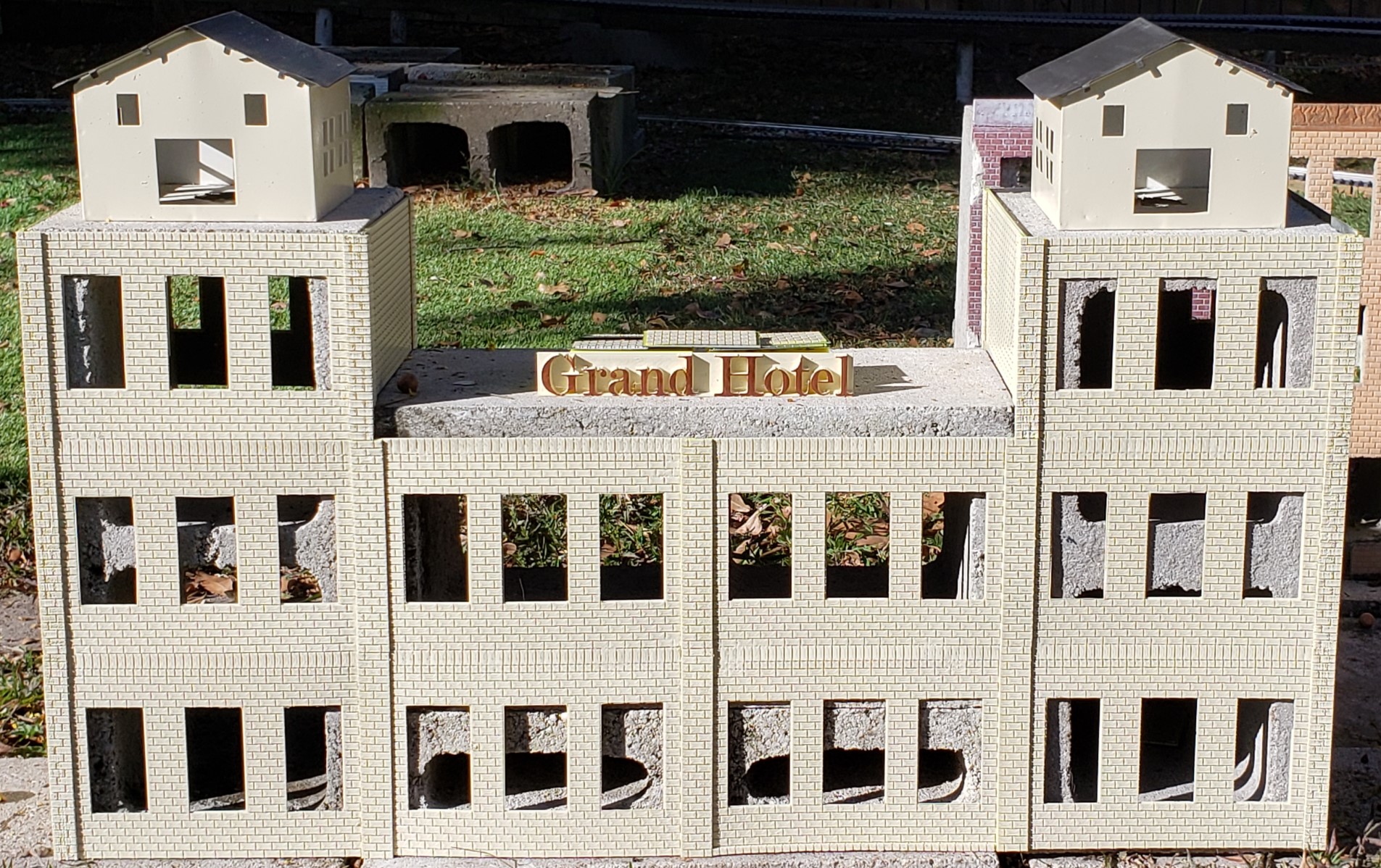
But we needed more than those same tired buildings I cast so many years ago. Something more than three storefront apartment buildings. Something big. Something Grand. Hello Grand Hotel!

But that still wasn’t enough. Those foundation blocks with their corner cutouts have been patiently waiting for some attention too. Hello Corner Drugstore!

All of these additions came together in the few weeks before Halloween. Most of the groundwork began in September, but filing our taxes stole time away from our goals. And we had many goals.

Glow in the dark ghosts. Lightning bolts striking the Grand Hotel sign which would then remain eerily lit. “Uncanny eyes” gazing about in the hotel’s elevator houses atop the towers on either end. Even a drive in theater playing horror movies!

The Result…

Alas, those were not to be, but there’s always next year. We are more than pleased with what we accomplished though! The customized lighting effects stole the show. They were the show!

Eerie “ectoplasmic” colors fading in and out. Bright blues coupled with flashes of lightning give the impression of dramatic and destructive electrical explosions. Surging waves of blood red, as if the building is breathing.

Here’s a look before we even had the Corner Drugstore finished!

The History…

It all started with the desire for better lighting inside our passenger car “fleet”.

All but a handful of these passenger cars are Bachmann, the style with two light bulbs inside and a 9V battery box beneath to power them. They really couldn’t be seen until dark and the battery usually only lasts a few hours until it’s dead anyway. Not real impressive…

I used 5050 LED strips for everything, starting with lighting under our patio train station platform… All 16 feet of it! These were pre canned light strips, complete with remote control and power supply. I even dug in an underground feed right to the corner of the platform dedicated to powering it.

The next step was to fit shorter segments of those strips inside a passenger car. This had a number of drawbacks. First, while small, the Arduino controller still didn’t fit inside the existing battery box. The Lithium battery is slightly larger than that. I designed and 3D printed one large enough to replace the existing battery box.

Fast forward to now. Many iterations of the design later, I switched to using 2812 individually addressable LED strips, for a number of reasons. What’s the difference? The power supply for one. The 2812 strips run on 5V, the 5050 strips require 12V. Not a showstopper, but it does require extra parts to boost the 5V supply I already have to 12V.

The biggest difference between the two types is the ability to address each LED on the strip individually with the 2812 style. While the 5050 version allowed me to mimic the effects of the pre canned units, I wanted to be able to have them individually flicker, even scroll in marquee fashion!

The Effects…

I started with the easy effects, jump, fade, flash, blink. I added the ability to individually address each “pixel”. Then I added the flicker. It can be adjusted to be as slow and subtle as a kerosene lamp to as fast as an arc welder, with a flickering candle flame somewhere in between.

The problem is all the effects are global in nature. That is to say, they affect ALL the LEDs at once. Only the “per pixel” selection allows for changing each pixel’s color independently from one another and the ability to scroll them (marquee).

I spent a good bit of time to marry the two versions together… The issue I have to solve is the all or one addressing, or rather, pixel addressing and grouping. In a nutshell, we have baggage cars (no lighting whatsoever), combination cars (baggage and passenger sections), full passenger cars, and what I’ll call a parlor car (with an additional lit herald on the back railing).

How to handle all these different situations in ONE implementation? The hardware was identical, with 24 LEDs for each. The only exception is an extra 3 LEDs for the herald. The software is as generic as well. Each car has its own configuration that describes its unique situation.

If I haven’t mentioned it before, all these “gadgets” use a web browser interface for control. The embedded Arduino controller has built in WiFi. It operates as an access point that will allow other devices to connect to it as well as connecting to an existing WiFi access point as a client.

All of this allows the Arduino to act as a web server, serving up the control interface web page, available to any device on the network! Smart phone, tablet, laptop, you name it. If it has a web browser, you can control it!

I’ll add a video capture of the interface in action soon…

The old version only accounted for baggage and passenger sections of the combination car. The herald lighting wasn’t even addressed. It’s a step by step approach. First the LED and group addressing. The next is modifying the effects selection for each group and pixel.

In the process, I had to “wedge” the new additions into the existing status reporting mechanism. I pretty much gutted the entire per pixel reporting mechanism and refactored it to better fit into the group addressing scheme. Needless to say, the per pixel addressing functionality was the last to come back online.

Without getting into too much detail, there are two sides of the coin we’re talking about here. The client side and the server side. The client side is the browser client, consisting of HTML web pages, CSS for styling, and javascript for the nuts and bolts programming “smarts” behind the button pushes and handling the web socket interface to the web server.

The web server is the Arduino side, serving up the control interface pages and taking the appropriate actions when commanded. If this is all Greek to you, that’s alright. It’s a lot of programming jargon if you’re not interested.

If you are interested and would like to know more, leave a comment and I’ll be happy to answer any questions you may have. If there’s enough interest, I can add more detailed posts that describe how this all works.

The Ghost Town…

I had to further adapt the passenger lighting controller to become the ghost town controllers, starting with the Grand Hotel. But that’s not the only thing we needed. It would help if we actually had a Grand Hotel! For that, I cobbled together a number of 3D print designs I’d been working on to improve the casting process in the form of custom molds.

After many iterations, I finally managed to match the brick pattern sheets I used to cast the original storefront apartment buildings. In fact, I came up the the positive version before converting it to the negative impression suitable for use as a casting mold.

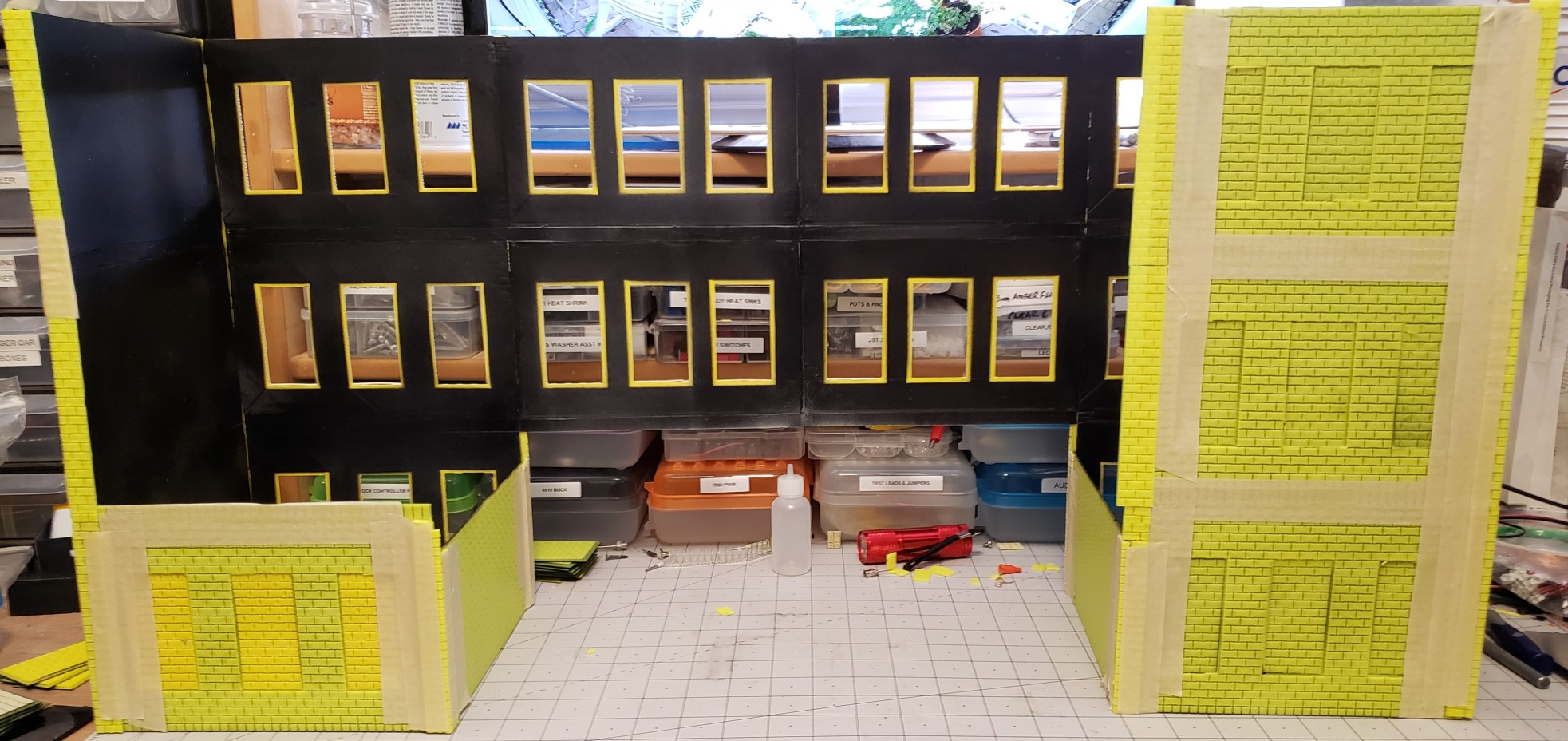
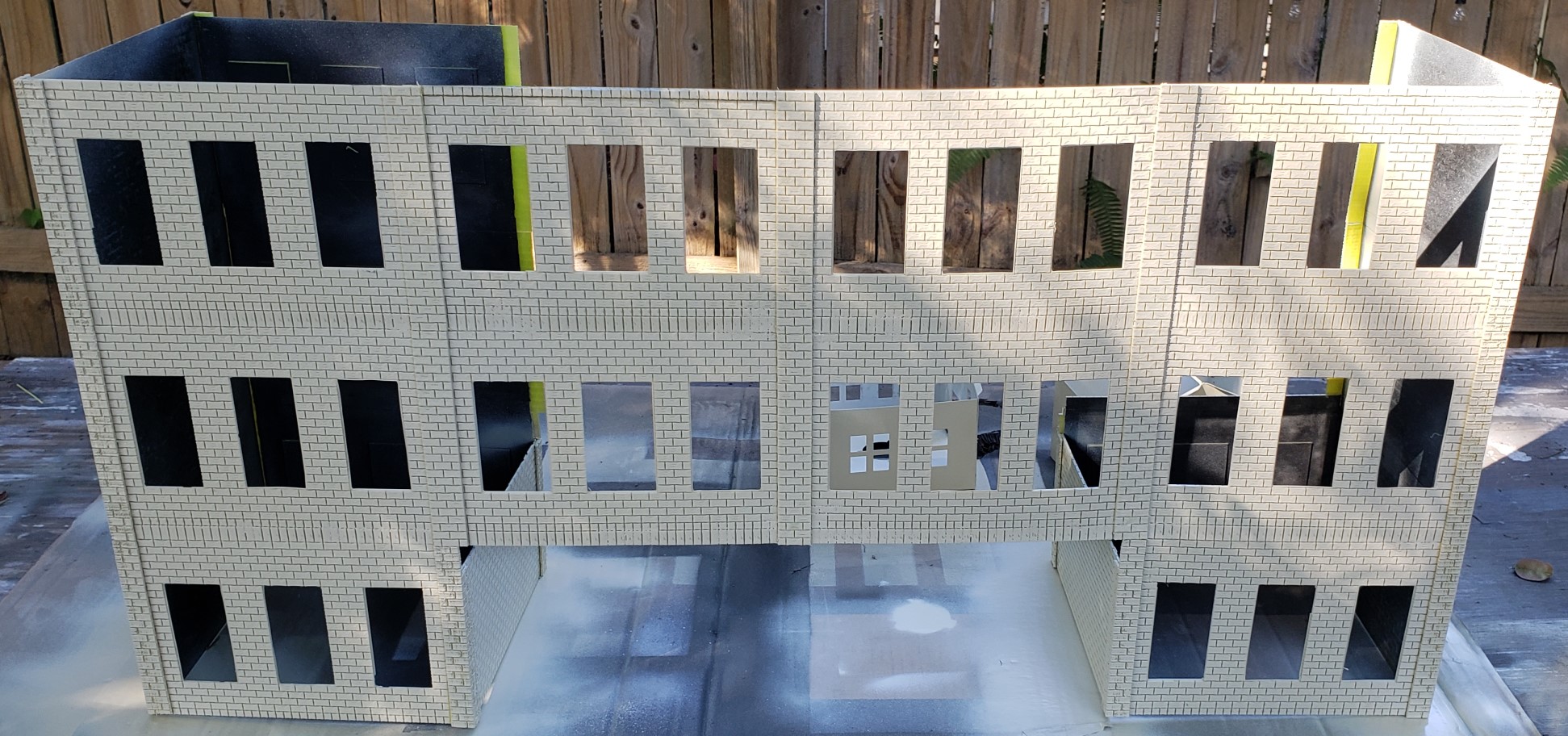
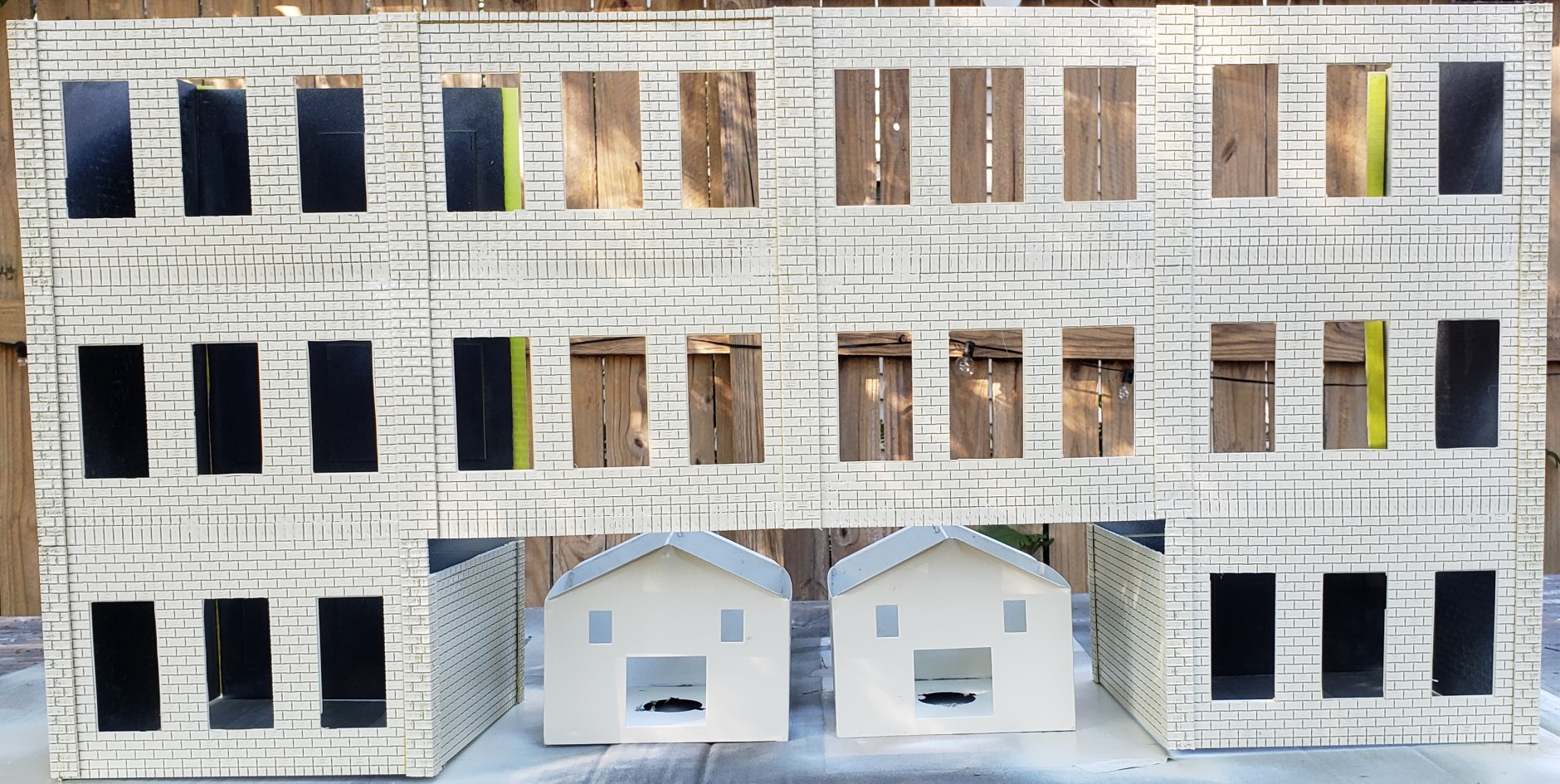
With a few changes here and there, I can print the various pieces of a building, one floor at a time. In essence, I’m converting a concrete block into a building using a 3D printed skin, one 5″ x 8″ section at a time. The sections are then joined together similar to styrene models, using a different liquid cement (chloroform), together with brick strips that mimic columns and headers.

If you’re a model railroader in smaller scales, you’ll recognize the approach is similar to Design Preservation Models modular kits. They supply a set of walls, window, door, and other detail castings, and the assembly instructions. All you need is glue and paint.

The resulting “skin” then slides over the block, after painting of course! It’s obvious the window frames and glazing are missing, but that’s what prompted us to make it a ghost town in the first place! The original buildings had both window frames and glazing in addition to a ground floor store front at first, slowly demolished by continued collisions with the pups.

I start by assembling floor sections together into a single three story wall then comparing it to the block. My first attempt fell short… Literally. Had I butted the brick header strips together with the sections to be joined instead of overlapped on top of them, it would have been just about the correct height.

The Grand Hotel…

Armed with this information, I began to madly 3D print wall after wall. I already had a few walls that I had previously printed, attempting to recreate the existing storefront apartments. My first attempt left too large an opening for the windows. The next attempt matched the window openings very closely, but added an extra brick to the width.

Great for ¼” thick castings… For a 0.072″ plastic brick sheet, not so much. The great thing about thin plastic sheet is how easy it is to cut with a good pair of scissors! Not Kindergarten scissors and construction paper easy, but easy enough to trim half a brick off either end without much bruising…

This is a seat of the pants operation here. It doesn’t need to look perfect and it doesn’t need to last, it only has to resemble a big hotel from a distance at dusk. If you look closely, you’ll see there are no doors anywhere on the ground floor. Kind of like Hotel California, “You can check out any time you want, but you can never leave”, assuming you could get inside in the first place!

In any case, I soon exhaust the entire replacement spool of yellow filament. I screwed up getting the hub to fit inside when I first got it and it’s been hanging there ever since. The fear was a tangle in the line will cause a knot and jam the printer extruder. The result? A failed print at the very least. A flying spaghetti monster if not caught in time.

I was lucky this time though. I was present for most if not all the printing. Each section takes about three to four hours to print, so I continue to update my Arduino code while printing continues in the background behind me. Not only did I exhaust that entire replacement spool, I went through another regular spool as well, plus part of a second!

I had to wait on the second regular spool to get here too! The hotel is complete except for a few sections, so at least the side that shows looks like the Grand Hotel.

The Corner Drugstore…

The Corner Drugstore was meant to be printed from a spool of brick red colored filament I ordered especially for it. There’s something to be said for sticking with the known quality of a brand of filament. Apparently, I chose poorly… I tried three times to get a print just to stick to the bed before I finally gave up and threw it off to the side.

I loaded up my usual brand of filament in the bright red variety and had nothing but perfect prints one after another. This building is different than the others in that the corner entrance wall and doors will be at a 45° angle to the side walls. With barely enough time left to print the side walls themselves, I didn’t take the time to design the entrance and the 45° column pieces.

I did design a different set of window walls though. Two large windows per section for the bottom floor, as if there is restaurant seating, and four small windows for the middle floor sections suggesting a mezzanine. The upper floor sections are the standard three window apartment style windows.

I even added a set of alley side carriage doors with a small office door beside them. It went together quickly, but not quickly enough. I was still adding those finishing touches Halloween night! I ran out of time to cut the aluminum extrusions to size for the LED strip to fit inside.

Not even the original storefront apartment buildings had them, just the Grand Hotel, and even then those were cobbled together and barely fit inside the blocks. I needed something to diffuse the bright spot source of the LEDs. Even with the diffuser covers snapped in the extrusions over the LED strips, they can still be seen and it’s obvious they’re LEDs.

The only “pictures” I have are actual video recordings of it, and even then it’s just the incomplete skin. At least it’s painted brick red and has the lighting effects installed! It was a rush job to say the least. I was lucky to get as much done as I did. Here’s what the end product looked like. Hope you enjoy it as much as we did!

Most of the work remaining on it and the rest of downtown will wait until the new Main Street design is finished. The idea is to pour a thin concrete “sidewalk” that will serve as Main Street and the side streets, including curbs, sidewalks, and a firm, level foundation for all the buildings. But that’s another project for another time…

The Code…

The code has evolved over time, based on the success of previous additions from various projects. It all started with the WiFiTrainController Arduino sketch Nick put together a few years back to control his Lionel trains. Between his inspiration and my renewed immersion into embedded systems control at work, there’s a strong motivation to return to my “gadgetronics” days of the past.

After a number of iterations of modifications, and many failed attempts at getting reliable readings from Hall effect current sensors, I finally stumbled across the resolution to the problem. Unfortunately it meant going in an entirely different direction. That resulted in more iterations and improvements, and some refactoring along the way.

All that work on the block and motor controllers paid solid dividends going forward. The expanded web socket interface was far beyond the original single character command approach. Adding new commands is as easy as adding the command keyword to a map of handlers and pairing it with a new command handler to take the appropriate action on the server side.

This scaled nicely when I began working on the passenger car lighting projects, the direct ancestors of these building lighting effects projects for Halloween. First it was my “Glow In The Day” clocks, 3D printed in glow in the dark filament, then illuminated with UV LEDs to glow in the daytime. Now it’s the downtown ghost town.

Actually, it’s three separate projects, one for the Grand Hotel, one for the original Storefront Apartments, and one for the Corner Drugstore. The code for all three is basically the same except for the number of LEDs controlled and the user interface pages themselves.

In more detail, the projects consist of an Arduino sketch (written in C) and the data files. The NodeMCU 12E controllers are ESP8266 based and contain 4MBytes of flash memory. This can be divided between the two parts, in 1MByte increments.

The program sketch is compiled into an executable binary that is uploaded to the first part of flash memory. The data files are stored using the SPI Flash File System (SPIFFS). It’s a flat file system, but provides hierarchical storage via the file name itself. This is where the web pages, CSS, and javascript files are stored that are served to the web browser.

Here’s a video example of how we select and control the lighting effects we used for the ghost town. As you can see, there’s even enough room in the flash memory for a couple of smaller image files.

The Finish…

I used a dedicated power bank (20,000mAh) each for the Grand Hotel, Storefront Apartments, and Corner Drugstore. Each had its own dedicated Arduino controller as well. I was able to connect to each controller with my phone and the office PC to control them! The only thing I wasn’t able to pull off was the passenger car effects.

I thought I could spend a couple hours and get something whipped in to shape and working, but it was not to be. In fact, it took more than another week to get things the way I wanted them to work. But that’s software. If you wait until it’s perfect you’ll never have anything to ship!

As an experiment, I left the effects running all night long. They were still going in the morning! The power banks were fully charged Halloween night, with somewhere between 25% and 50% of the 20,00omAh charge remaining. I was also quite aggressive with the LED levels for a more dramatic effect. More conservative selections would last even longer.

By comparison, the passenger cars have only a tenth of that power (2,000mAh), and with more subdued lighting levels they are still running in the morning as well. I can get anywhere from 8 to 12 hours from them on a single four hour charge.

Stayed tuned for more updates on the passenger cars and the Barkyard too!


Happy Anniversary!

It’s Our 38th Wedding Anniversary!

Getting Ready For Fall

Ann and I were chatting about the Barkyard this morning and all the things we want to do. All the things we still have left to do. Things like launching the website so that it’s more than just a landing page. Things like producing videos with trains, not just the pups. After all, it is the Barkyard Railroad!

Our “online presence” is still under construction, to borrow a now antiquated description from the web design museum vault. These blog posts should help fill out content, but the idea is to welcome folks to our Barkyard and to share our enjoyment. Share our experiences. Share the latest developments.

It’s almost September already, what most folks would consider the beginning of Fall. Ann is ready to start the transformation from Summer to Fall. Fall colors. Fall flowers. Fall decorations. You know, bales of hay, scarecrows, pumpkins. Those sorts of things.

Ann mentioned how the “Downtown Marketplace” is looking more like a ghost town these days, and she’s right. We had storefronts and windows and streets, but the constant pounding from the pups have reduced our buildings to empty shells. The streets trampled to rubble.

While it’s a bit disappointing, it just another “puppy proofing” opportunity. We hope to have the time to transform downtown into a true “ghost” town for Halloween, with more castings, lights, perhaps even sound. It’s an aggressive schedule and will take time to accomplish to be sure.

Our Plans

Here’s of photo of what we have to start with for the ghost town. Those three buildings on the left used to reside in the gap to the right. Ann moved them out by the switches to act as a block to keep the dogs from destroying the now unobtanium turnouts.

Ghost Town
Ghost Town

Where they stand now was supposed to be the site of the Grand Hotel, but we never really figured out how to make the castings work for anything more than a single concrete block. Well, not so much figuring it out as much as moving beyond the limitation of a single casting no larger than a concrete block, constrained by the size of the largest pattern sheets.

I’ve been designing some new 3D printed molds that can be joined together into a single, larger “all in one” mold. Our largest pattern sheets (15″ x 15″) are more than four times the size of the available print area (8.5″ x 8.5″). That work is on hold at the moment while we continue on the website. It won’t be long now though. To give an idea of how long it’s going to be, the photo is already more than a month old.

Maintenance is another big ticket item. We had just finished replacing more rotted wooden stringers. You can see a couple of new slats sitting on the sawhorses in the background. We found out the hard way that even though those stringers are not sitting in direct contact with the ground, the dirt splashed up by raindrops is just as hard on them. But we’ll cover that in another post.

Once we get past Halloween, we plan to “refurbish” Main Street. We used “Hardi-Backer” board as the “pavement”, cut to size, and surrounded by concrete block “caps” to simulate a raised curb and sidewalk. While the “Hardi-Backer” holds up to the elements and resists rot extremely well, it’s no match for the constant pounding.

The plan is to cast the streets in concrete, and the sidewalks and building pads for that matter. Perhaps even casting a brick veneer to simulate old time pavers. Brick streets were far more common than concrete roads a century ago. Some brick roads remain in the NE Ohio town where we grew up. Even here in Apopka FL!

What’s Next?

Our intent is to increase the amount of video footage we share. At this point, anything would be an improvement to the handful of short clips of the pups on Facebook. We don’t even have a trailer for our YouTube channel yet!

Feel free to leave us a comment.

Adding Details To Downtown Building Castings


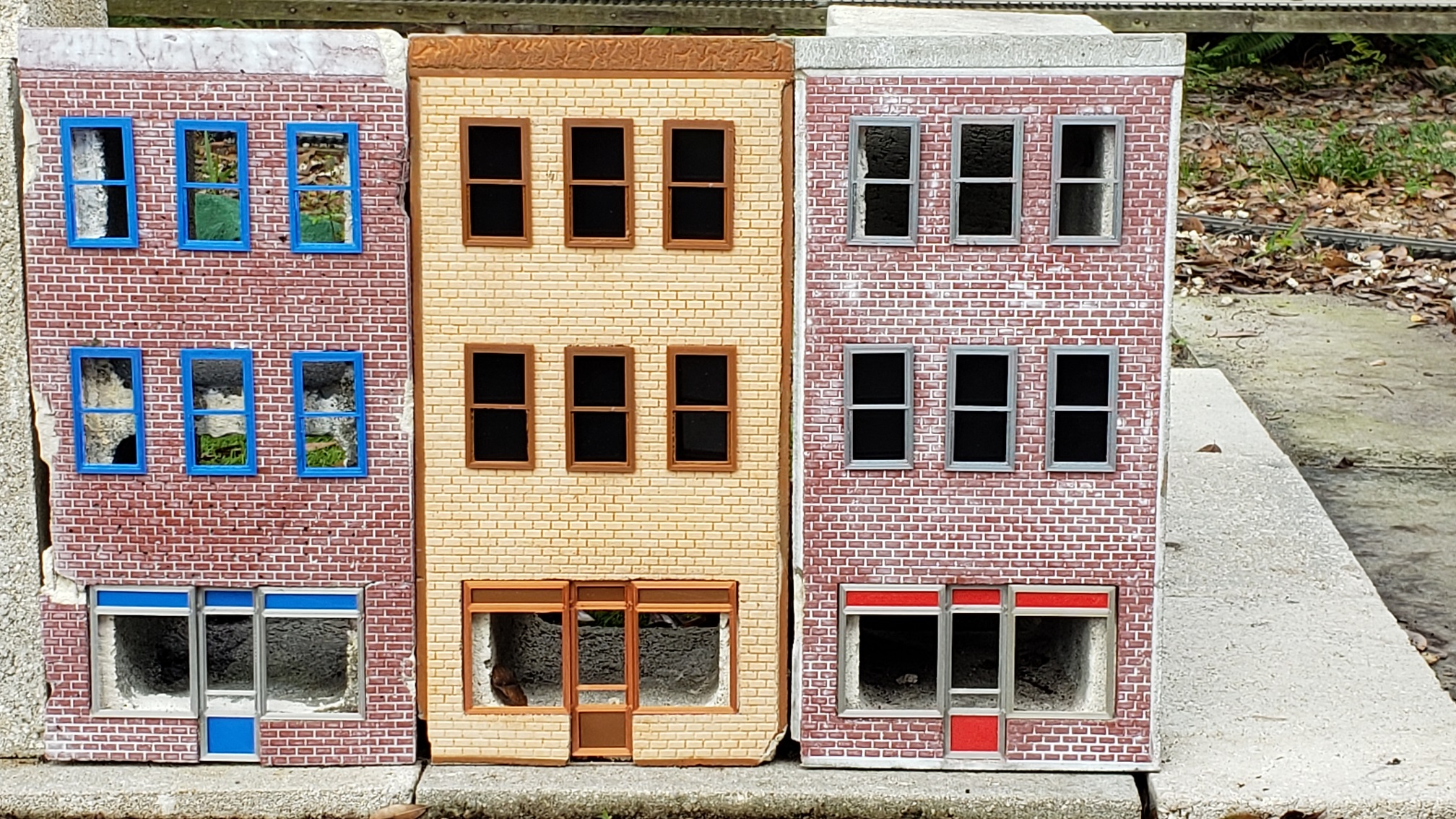
The Featured Image above shows the results of our efforts so far. Below is what we started with… Three very rough castings obviously covering concrete blocks.

Rough Castings
Rough Castings

I’m designing the downtown market display case view blocks to conceal the edges of the concrete block on the first floor. I don’t really have a specific example of a building to model in mind, just a vague recollection from my childhood of what buildings looked like.

The building itself is based on some of the HO kits I assembled ages ago. These kits all start with the same narrow faced three story building, but add different details, like a funeral parlor or a five and dime. The bottom floor is always different, but the upper floors have similar window frames and clear glazing. Even brick patterned blanks are supplied to close off openings if desired.

I’ve already designed the window frames, experimenting with different glazing. With nothing to conceal the concrete block behind, it was obvious something was needed. First I cut some opaque black ABS to fit behind the frames. It definitely blocks the view! But unfortunately, it also means lighting is out of the question!

Downtown Marketplace Windows

In the Featured Image, the building on the right shows the different between nothing behind and black ABS. The building in the middle show what the translucent green looks like compared to the ABS. None of the building have the display case view block installed yet. See the end of the post for a view of all everything populated.

I’m also trying out the “see through” dark green filament I bought, as a stand in for the soda glass of the day, or perhaps tinted glass on automobiles. Hopefully. It’s a little dark for the window glazing, but looks better than the clear filament, which is anything but clear. Translucent perhaps, but it just looks too white and opaque.

When I had just the black ABS cutouts behind the frames with no glazing it looked better than the translucent “clear”. And now the new translucent green looks better than the ABS view block. I need to experiment with back lighting and see if it still looks as good.

Even my “venetian blind” modification doesn’t look like anything but opaque white! It works only slightly better with the translucent green. Perhaps once it’s backlit it will look like blinds covering the inside of the windows. We shall see…

Downtown Marketplace Window Glazing

Iterations and Alterations

Just as the window frames underwent a number of modifications, so did the design, fitment, and assembly of the display cases. The original casting is meant to have two display cases behind large, transparent windows, one on either side of the entrance which is placed in the middle between the two.

The entrance represents a metal framed door with a transom above, typical of the era. For variety, the transom can be fitted with a more modern air conditioner. For now, I’ll concentrate on getting something there first. Details can be added later.

The entrance will be assembled from the three pieces previously described, due to limitations of 3D printing. Overhangs are a no-no. They can be overcome using supports, but it’s more work to clean up the traces left behind by them. The tradeoff is gluing the pieces together, but how to glue them together? We need something to glue together first…

Printing Storefronts

The beauty of the design’s symmetry is both display windows are identical, allowing both sides to remain a single, interchangeable assembly. Together with the door assembly, they can fill the void of the street level opening meant for them.

I recently purchased an assortment of “metal” filaments for the 3D printer. I’m hoping the silver looks enough like an aluminum frame to pass as metal. Even just the standard silver (gray) filament will look enough like an oxidized galvanized finish, so it’s not really a problem if it doesn’t. It still looks better than nothing!

I already printed window frames using the plain silver gray filament, so I print a set using the silver metal filament first. The showcase frames have a place for colored insets above both the door and windows, as well as the bottom kick panel of the door.

Rather than print the insets in the gray color, I decide to use red to make it “pop”. I refrained from printing more window frames in red for fear it would be overpowering against the brick red of the casting. The gray will work well enough for now.

But the real test will be the copper color! I’m thinking about using it for the cream colored brick building, together with brown inset panels, to really make it “pop”! I can’t wait to try it, but wait I’ll have to.

Assembling The Storefronts

My first prints of everything need revision! The frames don’t fit together the way I want them to without a redesign. Even then, the next version still needed some judicious filing, but that left the fit too loose. Even the insets don’t fit!

I quickly learned I need to leave about 0.010″ clearance between pieces if I want an exact fit, and by exact I mean almost an interference fit. I reprinted the insets and this time they almost “snapped” in place. I say almost because they are just loose enough to find their way back out on their own.

So not only do the frame pieces need to be joined together, the insets will need something to retain them in place as well.

Plastic Welding or Plastic Cement?

Even though we’re talking about adding details to cement blocks, the plastic cement we’re talking about is like styrene model cement, the kind that chemically dissolves the plastic together to create one solid piece once it flashes off.

I’m not sure what glue works on PLA. Acetone works for ABS, and supposedly for PLA too. A quick test says I don’t know what they’re smoking, but it has no effect. Model glue does a little better, but still leaves a lot to be desired. That’s not working. Next. I read good reviews about using a plastic welder, so I decided to buy one and try it.

The ones most recommended double as a child’s “toy”, but I’m not sure what parents would hand their grade schooler a hot melt glue gun these days. That’s basically what it is, except it uses plastic filament for 3D printing instead of glue sticks. And at 210°C (410°F) for PLA, it’s about twice as hot. May as well hand your kid a soldering iron at that point!

When it arrived, my first attempt at plastic welding two parts together worked, but with mixed results. It effectively joins the parts together, but the joint isn’t very strong. And like welding metal, it leaves a visible bead of material at the joint. Let’s just say it doesn’t look like a stack of dimes…

After assembling the first storefront, I am thoroughly discouraged by the results. Even though I was able to keep the ugly weld bead hidden from sight, it doesn’t hold the assembly together long enough to press it into the opening in the casting, quickly snapping apart!

My assumption that it physically heated both parts to welding temperature while adding filler material was not a good one. It basically melts only the filler material. There is no molten “puddle” of material like metal welding.

PLA Cement a.k.a. Dichloromethane

A bit more research finds that dichloromethane is the solvent I’m looking for… a.k.a. chloroform. Great. Now where do I get that? Even after all the “Does this rag smell like chloroform?” jokes, it’s surprising how many products use it as the main ingredient! Methylene chloride was widely used as a paint stripper, now both are banned banned, replaced by a far less effective ingredients.

Just be bopping down to the paint department at the local big box store sounded like a good idea at the time, but they no longer carry methylene chloride, let alone in those gallon tins. Guess I should call myself lucky to still be able to buy acetone by the gallon.

What’s amazing to me is there are still many suppliers online. I went with “WeldOn” products, no affiliation. It’s expensive for just a pint can, but they deliver to my door! There are a number of different “acrylic adhesives” in their lineup.

I tried their #16 first, which worked incredibly well on plexiglass, but is really thick. Too thick to seep into the crevices between the parts via capillary action. It works, but has to be brushed on, wasting a lot of it in the process, kind of like using a firehose to water the flowers.

I ordered their #3 and #4 variations next. They are definitely liquid, thin enough to flow into the tiniest of crevices. The #3 is quick acting and the #4 has a longer working time. Both flow easily into the joints. All three should be used only in a well ventilated area or asphyxiation could result.

Along those lines, this stuff needs to be tightly sealed so it won’t totally evaporate away. Both the #3 and #4 came sealed in heavy duty ziploc bags over the sealed metal lid of the metal can! The first time I used it, I found out the hard way how quickly this stuff evaporates!

Learning the Ropes

The small squeeze bottles with attached hypodermic needle that came with them have a twist-lock “cap” of sorts to protect the tip. More like to protect you from stabbing yourself with it, but even that wasn’t enough to seal it. I had a third of the squeeze bottle worth of #3 left in the bottom when I went to bed. It was all but gone by morning!

From now on, any leftover gets immediate placed back in the can and then sealed in the ziploc. I also found the needle to be prone to clogging with the dissolved plastic after a short amount of use. Squeezing it to blow out the clog either doesn’t work, or if it does, floods the work pieces with solvent.

I found a better way to dissolve the clog was just to hold the squeeze bottle upside down until the solvent itself dissolves the clog. It doesn’t take long and it’s fairly obvious when the clog is gone. Hard to ignore the solvent that starts streaming out again. After the first few uses and it taking forever just to get enough sucked up into the squeeze bottle through that small needle, I decided to find some larger versions.

I now have so many of them, I can’t give them away, but the thought was they would fill quickly and I could use them to quickly transfer the contents into the hypo bottle. They came with an attached silicon cap to cover the larger, blunt tip, but even they don’t seal well enough to leave any leftovers inside for more than a day or so. I’ve gotten in the habit of pulling out a little solvent at a time, using what I need, then returning what’s left to the can when finished.

The Test of Time

So long story short, after a few false starts, we finally managed to get those three buildings looking more like a downtown business than a concrete block. They still need modifications to continue to serve us as downtown marketplace buildings though. The elements were not kind to the PLA plastic, as seen in the picture below.

Faded Glory
Time takes its toll on the PLA plastic exposed to the elements

I should have used some adhesive caulk to hold the windows in place too. Slowly but surely the dogs managed to knock out every single window. It got to the point that every time I went out to work on the Barkyard, I had to pick up a couple more windows, just laying in the street or on the ground. I started a collection of them in the garage so as not to lose them.

Next go round I’ll need to paint the plastic with UV resistant paint, maybe even just a clear top coat, but an opaque color will provide far more protection from the sun than clear coat ever could. At some point I really need to get some display cases put behind there though.

I finally removed the ground floor display cases and stashed them away too. Ann says it looks like a ghost town. So we’re thinking of making more castings, enough to build an entire ghost town downtown for Halloween! I’ll need to accelerate my efforts to add lighting and other “spooky” effects, but it should prove entertaining regardless.

Our First Casting

Why Casting?

The title should really be “Puppy Proofing”. They can certainly inflict some serious damage! One of the main themes of the Barkyard Railroad is sharing the space with the “pups”, so everything must be built much stronger than normal in order to withstand a direct impact from a hundred pound German Shepherd at full gait.

Another consideration is the longevity of any structure outdoors, under constant bombardment from the elements. Most plastics quickly becomes brittle after baking in the sun. Even treated lumber quickly rots in this environment.

Along those lines, I found an interesting approach to outdoor structures online, in the form of cast concrete. More accurately, cast concrete patch. I will include some links to this inspiration, as well as my source of pattern sheets for casting.

Lay out
Test fitting

A brief introduction to the technique is warranted. Using extruded foam insulation as a sort of “backer board” for the pattern sheet(s), inserts for openings like doors and windows are also fashioned from the rigid foam, then “T” pinned in position over the pattern.

Pinning Together
Pinning it all together

There are many different types of pattern sheets available. Brick, concrete block, lap siding, and corrugated roofing are but a few examples of the many types of pattern sheets available. I started by acquiring an assortment of different pattern sheets from various sources.

Although a specific pattern sheet may be found online, its availability is certainly hit or miss, especially when searching for G scale items. But that seems to be a common theme for anything G scale. The next obstacle is finding suitably sized pattern sheets.

Patching a mold together across multiple pattern sheets is problematic at best, creating a “parting line” effect in the casting. To avoid this, I chose to start with a 15″ x 15″ square brick pattern sheet. The resulting casting will cover one side of a concrete block, roughly 8″ x 8″ x 16″ in size.

Why a concrete block? Because it is immediately more puppy proof than just a thin casting. This technique also calls for an embedded wire mesh frame to provide strength for the brittle casting. The issue becomes how to manage parts that require multiple castings to complete due to their shape or size, a pitched roof casting for example.

For a pitched roof, only one face or the other can be cast at once since the mold must be level. But the mesh must be formed at an angle across the roof peak, with the other half protruding from one side’s casting until it cures. The other side can then be cast, but this presents the unique challenge of fixturing, somehow propping the previous casting in place while the new one hardens.

There is no easy way to cast a four sided building using a single piece of wire mesh. The challenge of keeping the first wall standing and squarely aligned while casting the second wall is difficult enough, but consider trying to hold three walls in place as the fourth is cast.

That last wall would also require somehow connecting the ends of the mesh together, either from the start, or allowing enough to extend from the first wall to fasten to the other end of that last wall. Extending the thought of somehow connecting the ends of the mesh together, just folding up the edges to leave about half an inch of the mesh exposed should do the trick.

Mesh Insert
Wire Mesh Insert

The Pour

With everything pinned together and the mesh cut to size and in place, it’s time to mix up the concrete patch and pour. Having never done this before, the consistency of the mix is in question. “Pancake batter” can range from runny to thick enough to require a ladle, so opting for somewhere in between seems the best bet. A dedicated mixer is recommended, so opting to hand mix presents its own challenges.

While the mix slacks, everything is sprayed with the mold release agent, WD40 in this case. Although the “batter” seems to be thoroughly mixed, the patch wants to settle out to the bottom of the mixing bucket. The closer to the bottom of the mixing bucket, the thicker the consistency becomes. Working around the inserts is difficult with the thicker mixture and even a small trowel isn’t helping much.

The Pour
The Pour

Once poured, the mix needs to be vibrated into place to remove any trapped air bubbles, like real concrete. A handheld jigsaw was recommended, minus the blade of course, but a palm sander will do in a pinch. The idea is to vibrate all around the mold, and for long enough to allow the bubbles to float to the surface and burst. Now all that remains it to let it set up for 24 hours then remove it from the mold.

The first attempt at removing the bubbles proved to be an exercise in futility. While the plywood bench all around the insulation base was vibrated, many bubbles remained trapped. And while all those minute voids in the casting can be filled, it’s more trouble than it’s worth. The take away is next time, the mix must be thinner, and the mold itself will be vibrated directly.

Once the casting had cured a few more days. it was painted. And a nice brick red it is. The air bubbles still show, but aren’t discernable from a distance. The “Five Foot Rule” is in full effect on this first one, a learning experience for sure.

Another lesson learned is to wait until the casting is no longer “green”, that is, fully cured before fiddling with it… let alone flexing it or the exposed mesh along the edges. The missing edges where the casting fell apart because of that flexing are much more noticeable than those tiny voids in the brick face from the bubbles.

The Final Product

After painting, the casting was secured to the concrete block using thin set mortar. The missing edges were filled in as well, to look like a “repair” of sorts to crumbling bricks along the edge of the building. Now all it needs are windows for the upper floors and display case windows and an entrance for the ground floor.

Our First Building
Our First Building

All in all, our first building casting for the downtown marketplace is a success. Is it perfect? By no means, but it certainly looks more like a three story building than a bare concrete block does! Some “window dressing” and other details will make it an even more believable model.

Lighting is another consideration, and by extension, how to power the lighting. But all that will wait for another installment. We started working on the downtown marketplace back in June of 2019, so there is plenty more to come. Stay tuned!

If you have any questions, or you would like to see more detail, leave us a comment.

Building A Howe Truss Bridge

Building Our First Bridge

Our garden railroad is progressing, but we need a bridge. As with the trestle bents, this post is a foreshortened version of all the research and planning involved. I’m an incurable rivet counter when it comes to details and modelling, a hold over from my HO scale days, so it is difficult for me to accept anything less than prototypical.

The approach I settled on is, shall we say, less than prototypical. But it does allow for “quick” assembly, combined with a modular approach. And again, like the trestle bents, it requires a jig. Beyond that, it also requires additional brass hardware… Threaded rod, nuts, and washers for examples. I chose to use #2-56, but #1-72 would be closer to scale.

The modular approach is an adaptation of a commercially available system for building a Howe truss bridge. The modular concept to based on “opposed overlapping” end pieces, coupled together by multiple standard overlapping sections. A prototypical Howe truss bridge is composed of massive compression members, and comparatively “puny” tension members where iron rods assume the tensile forces.

Sounds like too much engineering mumbo jumbo? The quick and dirty version is wood doesn’t take kindly to stretching, and metal doesn’t like to be pushed, even in the form of a spring. The design of a Howe truss accounts for this and it’s appearance. Another feature of its appearance is the reason why my rivet counting background makes this difficult for me.

The prototype uses a metal casting to bring all those components together, a component I cannot replicate with the modular approach I adopted. Someday perhaps, but not now. The prototype does not use the massive 12×12 beams, both above and below, to contain the trusses and terminate the tension rods. But I’m getting ahead of myself. We don’t even have trusses yet!

Building A Truss Jig

After a number of false starts, I finally came up with a final design and a jig to hold thing together for assembly, which starts with placing upper and lower members. Then the first course of diagonal compression members are placed over those.

Another set of upper and lower members is placed over those, but these are a “cell” shorter than the previous. Then another course of diagonal members, this time in the tension direction. One last layer of upper and lower members, yet again a “cell” shorter.


Hopefully the pictures are worth thousands of words, but perhaps I should start with how I made the jig. I learned from my experience with the trestle bent jig and started with a chunk of ¾” plywood. After carefully calculating the placement for the upper and lower truss members, I proceed to cut ½” wide slots for both members, 3⁄8″ deep, using the router.

Those upper and lower members are only ¼” thick, but the jig must be recessed enough to allow for the diagonal members to be placed over them, which accounts for the 3⁄8″ depth. Again using the router, I cut slots for the first course of diagonal members, this time only 1⁄8″ deep. I’ve never really had much success with using the router, even with a guide, so I’m a bit nervous.

Those with a keen eye will notice that I missed by half an inch on the lower slot and had to cut another next to it in the correct position. I must have miscalculated, but thankfully was able to correct for it without having to start all over again.

Building A Truss

By building two of the end assemblies, one can be flipped over and placed on top the first such that the diagonals overlap and fill in where the other is missing them. A truss constructed in this manner will be rather short and somewhat useless, but it demonstrates the approach. Another picture is in order. The horizontal members are roughly nine inches apart. Where the diagonals meet them are about four inches apart. The minimum truss length is about two feet.

Modular Truss
Modular Truss Construction

A truss of arbitrary length can be constructed by first starting with a pair of end sections. Any number of intermediate sections can then be inserted between the two end sections, using the same offset technique for placement of the diagonal members, except the length of all the horizontal members of the intermediate section are all identical. The intermediate sections don’t necessarily all have to be the same length

This is the modular approach I borrowed in hopes of building the bridge trusses a section at a time, then later assembling them all together into one long truss, four feet long. The jig allows me to build intermediate sections up to two feet in length. Combined with the two end sections yields the desired four foot span.

Each and every joint requires cutting a piece of the threaded rod, and that requires chasing the threads, mangled by cutting. The rods come in three foot lengths. The joints need a chunk less than an inch long. Before cutting, nuts are threaded on the rod to chase the threads after cutting on their way back off, but this proves difficult and ineffective.

While using the nuts is good enough for proof of concept, the rivet counter in me prevails. A good set of threading dies make the task much easier. The correct sized machine bolt would be perfect, but the only items available in these small sizes are machine screws.

We’ll stick with the more prototypical nuts, although hex nuts aren’t strictly prototypical either. Square nuts and square headed bolts would have been used on the prototype. Also not strictly prototypical is the way the horizontal beams are joined, but short of stamping or casting joining plates that the prototype employs, this will be close enough.

The most frustrating part of assembling a truss is having to partially disassemble the modules just to join them together and reassemble. It’s hard enough for my fat fingers to fumble with threaded these tiny nuts on the rods once, but having to do it twice or more is trying my patience.

Perseverance prevails and I finally have two fully assembled trusses. Now to join them together into the final bridge span.

Building A Bridge

The two trusses are held together by pairs of scale 12x12s and tension rods. The scale 12x12s are cut to extend beyond the sides of the trusses. Holes for the threaded rods are drilled in the ends. Threaded rods extend through the pair of 12x12s, above and below the trusses, secured by nuts and washers on the tension rods.

Sounds simple enough, but no amount of hands seems enough to hold everything together while tightening the nuts on the rods. A different approach is called for. By preassembling the pairs and rods, sliding them over the ends of the trusses, then tightening to hold everything snug works much better.


Assembly continues by just snugging the rods at first, then tightening them until they can be “plucked”, like tuning guitar strings. More like bass strings as thick as the rods are, but they still make their own music of sorts.

As the rods are tightened, the structure becomes more rigid, but wants to twist the tighter they get. It appears the trusses are deforming under the force. Attempting to twist things back in shape causes the trusses to deform further.

We have a bridge! Good enough for now, but there shortcomings that will need work.

Items To Address

The first issue encountered is accurate and repeatable placement of the holes for assembling the truss members. A few modifications to the jig will allow the use of my dremel drill press and a means to accurately index the holes. It should help speed up assembly, but assembly will remain clumsy and difficult using the modular approach.

Another disadvantage is joining the horizontal members “together” where the diagonal members join. A less than rigid truss assembly produced. Even though the joints are staggered, the forces applied by the diagonal members tend to force the horizontal members apart, much weaker in comparison to a single member.

Slop inherent in the modular truss approach could be overcome using a number of different approaches.


Making Trestle Bents


Our First Post

This will be our first blog post ever and we’re excited! Just as eager to get our garden railroad off the ground and running, we’ll need a reason for it to be off the ground. And that reason would be a bridge. A bridge over something. And to get from the ground up to that bridge we’ll need an approach trestle.

Many folks have many different ways of creating a trestle. Even the different railroads had different ways of doing it, right down to the trestle bents. What’s a trestle bent? Well, there’s plenty of information online, but simplistically it’s the individual “tower” structure that is repeated and lashed together with the rest to create an assembly called a trestle.

The key word here is repeated. Most folks agree that a jig will help immensely when repeatedly constructing all those trestle bents needed to assemble a trestle. I’d be happy to make just one bent to start with, but know that I’ll need many more than that, so I make my first cut at making a jig.

Having just replaced the fence between us and our new neighbor here in Mount Dora, I have plenty of well weathered “scrap” wood to rip into the raw materials I’ll need. I start by ripping the scale 6×12 and 12×12 members I’ll need to cobble together that jig.

Our First Jig

Starting with a chunk of ½” plywood, the main “T” portion is aligned, then the angled members drawn in at 5° and 10°, respectively. The straps are drawn in every 10″, a scale 20′ at “half doll house scale”. What’s half doll house scale? Well, if “doll house scale” is one inch represents one foot, or 1:12, then half doll house scale is a ½” represents a foot, or 1:24.

Some would argue that G scale is 3⁄8″ represents a foot, 1:32. USA Trains uses 1:29. Since the Bachmann Big Haulers we have are supposedly 3′ narrow gauge, that would be 1:20.3, sometimes called F scale. I use 1:24 because it makes the math easy and it’s closer to F scale.

Add to that our goal of sharing the space with the “pups” – everything must be built much stronger than normal in order to withstand a direct impact from a hundred pound German Shepherd at full gait. A 12×12 post that is a ½” thick is stronger than one 3⁄8″, so there you have it.

Back to that chunk of ½” plywood… We’ll call a jig for now. Short pieces of the ½” thick scale 12x12s are attached with self tapping screws on either side of the five posts to act as guides. More are placed to help keep the top beam in position. The template helps hold the pieces in alignment during gluing and assembly, but it has shortcomings that must be worked around.

Cutting those posts to exact length proves to be another challenge. No matter how carefully cut, their lengths are just enough different to force hand selection of each piece. So much for assembly line efficiency!

The scale 6×12 pier sills that delineate each new section of the bent and associated scale 3×10 cross bracing must be attached from the top side and bent then removed from the jig to attach to the other side since no provision was made for them in the jig. Brass brads are used to simulate what would be nuts and bolts on the prototype.

The brass will weather to a dull brown to simulate rusted hardware, yet survive for years without further corrosion as iron or steel would.

Actually, the cross bracing is added last, hand cut to fit and tacked into place using some HO scale track nails! Those will rust away to nothing eventually, but they were only meant to hold the sills in place until the glue cured, and will provide a realistic rusted patina over time.

Our First Bent

Our First Bent
Our First Bent

This is all brand new, so I’m learning as I go. Ann isn’t very happy with me assembling these in the living room, but there is nowhere else that I can. The garage was really just the old carriage house, two strips of concrete over a dirt floor, with no lights or electricity whatsoever. We’ve added a wood floor, a side door in place of the old window, electricity and lights.

But it’s still a work in progress. I’m fairly limited without an easily accessible workshop. Thankfully most operations are limited to drilling pilot holes and tapping in brads after gluing the pieces together. I need a few quick clamps here and there to hold things together, but manage to get the first bent assembled.

After trying to remove the bent and reinsert it face down, it’s obvious that the jig isn’t even symmetric! It may have drawbacks, but at least I can assemble bents for testing and assessing other operations, such as assembling multiple bents into a trestle.


Assembled Bents
Assembled Bents

This post is a woefully foreshortened version of all the research and planning required. Some railroads used poles in place of posts. Some used four posts rather than five. Other configurations exist, such as those for two mainlines, with more vertical posts than one. This design is a compromise between the differences and meant for a single track.

It may not be symmetric, and it may not be pretty, but it’s a start. Next up is determining how to stain and seal the bents while giving the impression of creosoted posts and beams. Stay tuned for further developments.